Wednesday, February 11, 2009

Teaching Teaching vs. Doing Teaching

A debate of sorts (mostly one-sided, with me on the one side) has recently arisen on campus about the distinction between "professional development" and "faculty development," because our particular corporate culture thinks that college teachers constantly have to be taught how to teach, no matter how long they've been at it.

A few years ago, I wrote a rather infamous letter to our then-HR person when the faculty development (they weren't making much of a distinction then) requirement went up from twelve hours per academic year to eighteen--because we had been so good at meeting the twelve-hour requirement. I can still remember the opening line of the letter: "I don't know how you spent your summer vacation, but here's what I did"--and proceeded to recount everything I'd done on my two-week break between the spring and summer quarters. These included museum visits on the drive between Dallas and eastern California, visits to national parks, archaeological site-visits to photograph stuff I talked about in class, all in the ten days it took to drive there and back again. I even got in a couple of days' visit with my folks.

I returned to a notice during our "in-service" period (it's called Twelfth Week, but I don't think any connection with Shakespeare was intended), that we needed to jack up the hours we spent learning how to teach (or what to teach). Never mind that we almost never don't teach. This is a proprietary four-year college, in session forty four weeks per year, and full-time faculty are on campus thirty hours per week, teaching a required load of five four-hour classes (or combinations of course loads that add up to at least twenty hours). Comparable community college instructors teach five three-hour classes per semester (fifteen weeks), for two semesters, with extra pay for teaching summer classes. And although they are expected to show evidence of professional development and academic citizenship during their annual performance reviews, there is no "clock-hour" requirement and no distinction between "how" and "what" they teach when it comes to doing so (they can publish, go to meetings, participate in symposia, etc.). The semi-annual all-college gathering usually features a speaker who talks about new educational trends, but there are no required "PowerPoint and the Future of Education" lessons.

Okay, so we're different. Our faculty members are, for the most part, artists and design professionals who have not necessarily been mentored into teaching like most college teachers. New instructors (no tenure system here, so we're all "instructors") are required to attend faculty orientation sessions which include training in how to teach, the concept of a learning-centered environment (as opposed to a teaching-centered environment), and if, during their first few quarters they run into problems, they're provided with tools and training to help them get over the hump. The requirements are the same for both program and general studies instructors, even though gen ed graduates have almost always spent time teaching under the supervision of their professors.

Lately, however, the Powers That Be have decided to increase the faculty development quotient; we're now responsible for twenty four "clock hours" of training on how to teach what we teach. This is in addition to a less well-defined component of professional development, which encompasses fields of expertise. Because we are accredited by the Southern Association of Colleges and Schools (SACS), our instructors are now required to earn master's level advanced degrees (with corporate pressure to make these terminal degrees, such as MFAs and PhDs). This very fact makes professional development a no-brainer for people in grad school.

But here's my problem: why do we have to distinguish how we teach from what we teach in the first place? Socrates would most certainly be rolling around in his grave, since teaching and doing philosophy were, to him and to most of us who have adopted him as a model, the same thing. You are, as I keep harping, what you do. This is how philosophers see the world; one can't even really do philosophy without teaching it, because that's what writing and interpretation is all about. Some colleges, like Kent State, seem to make little distinction between the two, and I'm sure they're not alone.

I'm not saying that how-to-teach seminars can't be useful. A couple of years after my post-summer break tantrum, we had a workshop on how to create rubrics that describe what each grade we post actually means. What constitutes an A or B? What distinguishes a B from a C? This turned out to be such a successful strategy (because it solves the "numbers" problem for those of us who find it difficult to quantify learning) that I immediately went through my courses and objectives and made beautiful charts to help me determine how well my students were achieving the objectives. These are now tied to evaluation sheets that accompany every graded project my students submit.

I also balked at the idea of lesson plans (that's so high school, I smugly complained), but after laying out week by week and topic by topic what I wanted to cover over the quarter, and how I wanted to assess my students' accomplishment of goals, I was hooked. These plans have changed over the years as I modify content and approach (after using my reflective assessment process to figure out what's working and what's not), but they're also coming in really handy as I prepare to take a quarter off to get my heart working properly again--so I can go on teaching for as long as anybody can stand me. Sessions on how to construct good lesson plans would, therefore, be useful, especially for general studies types like me who are more used to seminars where everyone reads the same stuff and then discusses, interprets, and writes about it.

Art and design history courses, like those I mostly teach, require careful planning to make sure students are exposed over and over again to images, their context, and their history. They require critical analysis as well, which is difficult to accomplish in a school (and a world) where students just don't read. I can assign readings until I turn purple, but unless I test them on the content, they won't even click on the link that takes them directly to the pages I want them to consider, much less read and take notes on the content. I don't give true/false, multiple-choice, scanable exams, so students have to spend most of their time creating workbooks that contain images and notes based on the lectures. Nobody else I know of does this, and so over the years I've flown by the seat of my pants. I have to learn by doing, as I have this quarter, that just assigning the stuff isn't working. I'm going to have to develop activities for the workbooks that take them beyond the lectures (where they're often quite engaged and even curious), and more deeply into representative artists, works, and movements. I have to work even harder at finding ways to encourage them to actually think about what they're seeing.

In order to do this, I read books, scour the internet, read the Chronicle of Higher Education, and pore over popularized treatments of art history like Ross King's books (Michelangelo and the Pope's Ceiling, Brunelleschi's Dome, The Judgment of Paris, etc.) and Margaret Wertheim's wonderful explorations of the junctures of art, science, and technology (The Pearly Gates of Cyberspace). In fact, I read about thirty books a year on science, culture, art, and history--and I'm not sure why that doesn't count, even though these books--in teaching me about stuff I don't know and making me think--are teaching me how to teach. I also blog my brains out, which requires me to explore topics I might never have even thought of considering, as I respond to what others are teaching me.

The upshot is this: I cannot separate how I teach from what I teach. They are forged continuously together like the shards of Narsil into a complete sword, or knitting into a sweater, or layers in Photoshop into a finished image. Of course, nothing is ever finished, because everything flows--as the early philosopher Heraclitus famously noted. You may never be able to step into the same river twice, but if you attend to what you're doing, you'll notice how the stream changes, and detect patterns that might help keep you from falling in and drowning.

Enough with the bad metaphors. But my plea is that education, even in a corporate setting, be more accommodating to innovation and accident--and to process. Three hours spent sitting through a "stress management" session amounts to three hours I can't be reading a good book that will help me become a better teacher because it engages my little gray cells and causes me to make useful connections. If you want to manage my stress, get me a massage (we did that once; it was wonderful!).

Or, offer more of what a colleague and I did before this quarter began. One of our chef instructors and I discovered that we have a common interest in the history of food and how cultures develop their distinctive cuisines. So we put together a presentation on Egyptian food and culture (called, rather absurdly, "A Taste of Tut") that showed how the humanities and the culinary arts interact. In order to get it accepted as a suitable topic for faculty development training, we had to stress the interdisciplinarity of the project, and the co-operative aspect of the "teaching." But we had a great time, attendees learned some things they didn't already know, and the chefs made some great beer.

Now that's faculty development. But it's also professional development. So maybe we should re-think the distinction and become more generally interdisciplinary in our approach to how we teach what we do. I can almost guarantee that the faculty will be more content, less cantankerous, and more engaged--which, I suspect, would be good for us all.

Image apologies: Hendrick ter Brugghen's Heraclitus, at the Rijksmuseum Amsterdam. The Naples Socrates, by Domenico Anderson, in the Museo Nazionale di Napoli. Both via Wikimedia Commons. Heraclitus's tattoo is courtesy P22 Fonts (Acropolis Now) and one of Patrick Lynch's heart diagrams (see the Cabinet for more). I stole the idea for Socrates's mustache, of course, from Marcel Duchamp.

Friday, January 2, 2009

Reflective Assessment

A great deal of criticism is being leveled at the current vogue of high-stakes testing in elementary and secondary schools. And rightly so. I've actually blathered on about this issue on the Farm, but I've also been trying to figure out how to measure student learning without falling into the quagmire in which public primary and secondary schools find themselves. The push for numbers that reflect how students learn has produced an education system (if we can call it a "system" at all) that favors quantity over quality, and that makes good on its promise that no child left behind only by leaving them all behind together. Teachers, quaking in their boots over the possibility of being fired if their students perform poorly on poorly designed exams, teach only what the test requires, and the little automatons march out of school in tidy rows, knowing a few facts but having no idea of how to think.

And then they march on into college having also been sold on touchy-feely visions of their own worth as persons, given prizes for being there, and patted on the back and awarded a medal when they "try." To do otherwise smacks of elitism, and violates some bizarre notion of egalitarianism that equates existence with excellence.

And then we get 'em. What's a college teacher to do, when faced with a classroom full of shining faces that expect to be given grades, and rewarded with advancement simply for showing up?

A competitive classroom also can provide a rude awakening to the pampered, who tend to be ill prepared to fight their own battles or account for how they arrived at a particular solution. "I like the feel of it," they say, unable to explain why. Or even what "feel" means in this context.

So we deal with the situation however we can. We start them over, in essence, in order to give them some idea of how things will be when the enter the "real world" of the marketplace, using every tool at our disposal to help them learn how to take constructive criticism, analyze and solve design problems, or even help them overcome twelve years worth of not learning how to learn.

Every five years or so, along come the accreditation folks, to assess how we assess our students. Show me the numbers that indicate that you're constantly improving. Show me the tests, the charts, the rubrics, the data. But those of us who don't collect "data," who follow a more evolutionary process in our teaching, are left with a conundrum. Do we fall into the trap, contriving tests to "measure" what our students learn? Or do we continue to follow our teacherly instincts and use our training to understand what's going on in our classrooms, and try to address issues as they arise, term by term?

In wrestling with the fact that accreditation is here to stay, and that it does serve a purpose (it keeps some of the really shoddy operations at bay, and maintains basic standards that offer students assurance of at least a measure of quality), I've spent a long time thinking about how to assess the progress students actually make in my classes, but in an authentic, meaningful way. I can't really do it with numbers, other than by keeping track of grades, so there has to be a way to account for what goes on that doesn't rely solely on instruments like Scantronable tests.

As I looked back on how I grade and how I prepare for classes each quarter, I noticed a pattern. At about week 7 (of 11) I invariably start making notes about what's working and what isn't. One measure is to look at how students perform on particular exam questions at midterm. If a large proportion don't "get it" I examine my presentation of the material, the wording of the question, and even the classroom environment: the dynamics of a particular group, the performance of the technology I'm using, whether or not students are using computers to take notes, etc. Sometimes I can quickly determine the source of the problem and address it. I always go over the questions after the exam to obtain the students' perspectives, and then make note of the need for change the following quarter, or even on the final exam.

This had never been a particularly organized or formal process--just something I've done as a matter of course. And then I realized that the narrative I write every year for my performance review, about the year's successes and failures, reflected what I had learned from this informal process.

With these two basic elements in mind, I set out to create a template for a more structured process, and I came up with the following elements. I call it "Reflective Assessment" because it's based on the process of thinking back, and then thinking forward. It's probably something we all do, and it's a perfectly natural and certainly more "authentic" way to ascertain how well our students are learning than simply charting numbers based on tests that can't really measure thinking in the first place. As thought-provoking as I try to make my exam questions, they're never going measure much more than how well students have taken notes and paid attention.

The first step is to maintain a notebook in which to jot down issues that arise during the quarter. Sometimes these notes show up on sticky-pads and such, but these can be pasted into the notebook, along with miscellaneous scraps of paper we happen to have on hand while watching a film or during a lecture. The idea is to divide the notebook according to the courses we teach--one section for every preparation--as a way of centralizing what comes out of the everyday activity of lecturing, demonstrating, discussing, and whatever else we do as teachers.

The notebook then becomes the basis for a more formal reflection and assessment at the end of the quarter. I tend to do this anyway, as I update each syllabus, schedule, and (because I have internet pages for each course I teach) website, but the notebook now makes it much simpler to remember what needed changing, and often contains suggestions for how to make the changes.

In order to tie the assessment into the objectives of the course, a copy of the course rubric is should be included, along with the stated outcome objectives and exit competencies.

Before my annual performance evaluation, I now use the notebook, where I also record the changes I've made, to describe what has occurred in each of my courses over the year. In future, I can see the notebook's becoming a tool for developing new courses as well, and I'm planning to add a "curriculum development" section--at least until those ideas overflow the space allowed them and need a notebook of their own. I'm starting to write a quarterly assessment for each class, based on the notebook, with plans to consult it before I create my midterm exams, in order to make sure I'm attending to previous issues.

The main problem I've encountered with this system so far is that the notebook isn't always handy, which is why I like to have sticky-notepads among the materials I take to class, on my desk at school, and at home. I have one nearby when I'm grading exams and essays, too. The pads are getting bigger (the little square ones aren't all that useful), but it's rather entertaining to have a bunch of colorful bits stuck higgledy piggledy in the notebook--where they can be re-arranged as necessary. Different colored pads for different classes might be a good idea, too, but I'm not that organized yet. Mostly I use the free ones I get from publishers.

Since the process is fundamentally dialectical, the final step should involve discussing the results of each course assessment with the program or department Director, perhaps in conjunction with the year-end review. His or her comments could be added to one's teaching portfolio (I keep my narratives in mine), and the results of these conversations would provide an overview of the instructor's ongoing assessment process over the years.

The only drawback I can see to formalizing the process is that SACS evaluators might look askance at having to read through the notebooks, or even the performance narratives. But if they're really interested in transforming the quality of education by finding meaningful ways of improving instruction, reflective assessment will almost certainly give them a better picture of what's going on than a few pie charts would.

And then, of course, we could still illustrate each year's assessments with beautifully-designed charts and graphs that mark the rise and fall of grades and the vicissitudes of teaching in a world that doesn't really seem to want to learn. But that's another problem, for another day.

Image credit: Wall painting portraying a scholar, from Herculaneum, first century CE. Wikimedia Commons.

Monday, October 20, 2008

Trouble in the Garden

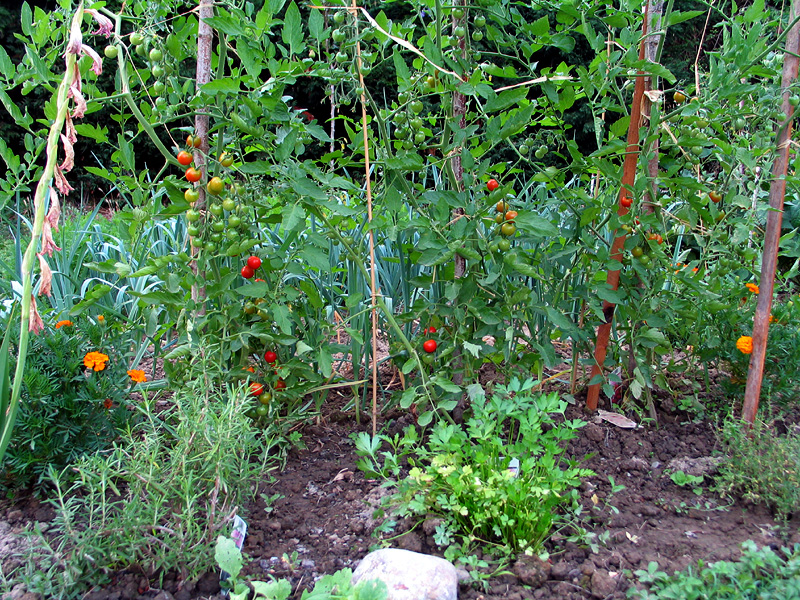
Back when I used to live in East Dallas, I'd often drive by Stonewall Jackson Elementary school on Mockingbird Lane. It's a fairly nondescript little school, but it sports a terrific garden that's visible from the street. I'd often see folks from the community, as well as the children, puttering around, and I was always amazed at how lovely, inviting, and verdant it looked.

Recently, however, the Dallas Independent School District--in response to its own idiocy concerning budget mismanagement--has decided to curtail this highly successful outdoor learning program despite clear evidence of its success.

Although Mark Painter will still try to maintain the garden after school hours (being paid by the PTA instead of the district) the overall stupidity of this move is indicative of how shallow our current approach to education has become. Experiential learning has been shown to enhance the learning process, especially in science and maths, by connecting students with real-world problems to which they can apply principles and concepts. Despite the fact that American students, especially those in urban areas, are scoring lower than ever on high-stakes exams in the sciences, this seems like the dumbest possible move any school district could make.

For examples of how programs like this work, I suggest looking at the University of California at Davis's Science, Technology and Environmental Literacy Workgroup, or at the Wildercom website developed by James T. Neill, a psychologist and environmental educator from Perth, Australia.

American students continue to be outscored by their counterparts in other countries, as shown in a recent Program for International Student Assessment (PISA) exam in science, and they trailed even further in mathematics. For details on the data, see the PowerPoint presentation by Andreas Schleicher, who analyzes the 2006 data in excrutiating--but rather interesting--detail, available on the Alliance for Excellent Education website. Schleicher is the director of PISA and head of the Indicators and Analysis Division of the Organisation for Economic Co-operation and Development’s (OECD) Directorate for Education. Further resources are available on the link.

I am certainly in no position to offer a great deal of advice about science teaching, except that I spent years working with kids at the Heard Museum and with the Plano ISD outdoor education effort. But I also love science, and I know how eager children are to understand the natural world. Our inability as a nation to inspire our children to understand scientific principles and seek careers in science will ultimately lead to our own intellectual poverty.

Ill-advised cost-cutting measures like closing down the garden program at Stonewall Jackson are simply going to turn around and bite us in the backside unless the educational bureaucracy starts paying attention to what really works.

Photo: a kitchen garden not unlike the one at Stonewall Jackson, by Jean-Noël Lafargue, via Wikimedia Commons.

Friday, October 3, 2008

Some Thoughts on Plagiarism . . . and how to avoid the problem in the first place

We live in an age of instant information accessibility. “Answers”—that is, facts, data, information—are only a Google search away. Almost inevitably, most commonly-used search terms lead directly to Wikipedia which, for all its democratic possibilities, is still only an encyclopedia. And encyclopedias are for high school, not for college.

The consequences of instant accessibility include impatience when it comes to refining searches, developing meaningful search strategies, and varying resource use. We’ve imbedded short attention spans into our children, and they are becoming increasingly impatient with research that takes “too long.”

I’m pretty sure that further consequences to the instant access phenomenon include a diminishing of wonder; many of our student lack the basic curiosity that leads to truly creative thinking, and because their reading is restricted primarily to popular culture, they lack the breadth of knowledge that used to lead to innovative connections. Couple this with impatience, and the result is a reduction in critical thinking and the acceptance of the “easy way out.”

Imagine this scenario: A student is given a standard paper topic, such as “Discuss the use of irony in Huckleberry Finn.” The student’s first impulse is to plug “irony” and “Huckleberry Finn” into a search engine and the results appear within nanoseconds. What happens next is the root cause of plagiarism. Not fundamental dishonesty, or profound laziness (although these certainly can be factors), but the sheer ease of cutting and pasting, and the perception that recombining the material from the internet magically makes it somehow original and acceptable.

For reasons that are much more complex than I want to go into, our students have been brought up to believe that learning should be fun—or, worse, entertaining. If they’re not having fun, and the task is taking too long, it’s just annoying. “This is boring,” I hear my students say, more often than I care to.

What these kids don’t understand is that, in the words of the American Arts & Crafts designer Dard Hunter, “Boredom is a matter of choice, not circumstance.” In fact, the choices that students are allowed to make often engender boredom, and initiate a cascade of problems that all too frequently lead to plagiarism.

So much for theory. How about solutions?

I would like to propose the possibility that the more innovative the assignment, the less likely plagiarism is to occur. For example, instead of assigning a hackneyed writing topic like “Discuss the use of irony in Huckleberry Finn,” how about asking students to pose questions that arise from their reading of the story? Why did something happen the way it did? Why were certain conditions present in the story? What makes Huck such an interesting character in the first place? Or instead of assigning a research paper on a general topic like “decorative glass” or “the history of the A-line dress,” find out if students are at all curious about anything related to the range of topics under discussion in the course. If they aren’t curious, perhaps the instructor could suggest questions that he or she has always wondered about.

A general rule to consider is that if the instructor finds grading the paper boring, the student certainly didn’t have much fun writing it—and probably didn’t learn much in the process. I have made it a commandment never to assign a topic that my students have not generated themselves, or that I’m not interested in enough to guide them toward looking for meaningful answers.


Another strategy involves asking students to evaluate all sources included in their bibliographies. I usually ask for general bibliographies (which students annotate to show me how they used each source) rather than works cited pages because they give me a better idea of the range of sources the student has consulted in the process of conducting research. In writing classes, for final research papers, I ask for both. I restrict the number of web sources in most cases, and usually require that they use a variety of media: films, print articles, books, interactive media (CD ROMs and DVDs). I hold research workshops where we discuss strategies for locating information and using the results. For material located on the internet, I require website evaluations to determine the quality of information presented: who wrote the article? What are his or her credentials? What is the source of the webpage—Personal? Educational? Business? Commercial? The annotations provide this information for other media—who wrote the book or directed the film? How is this material relevant to the research problem?

Ours is an institution that fosters creativity. We should therefore make a concerted effort to avoid assigning work that encourages students to think in clichés. Meaningful research, and original projects and writing, can only arise from engagement with the material. Our challenge as educators, therefore, is to provide good examples for our students. Initiate more creative projects that call for non-standard solutions; pose challenging questions that require students to break out of their “comfort zones” and into the real world of uncomfortable questions. A great deal of what I learned about teaching came from being an Olympics of the Mind coach, and having to guide seventh-graders through a series of problems without suggesting what they should do. They had to solve the problems themselves; all I could do was ask questions. My team members didn’t ever win the competition, but they did get creativity awards because their ideas were often both strange and beautiful.

One of the most useful assignments I ever undertook as a college student in philosophy was to argue a statement from a viewpoint opposite to that I held. Doing so forced me to see the other side of the question, and made me aware of the perils of faulty reasoning. But it was also extremely difficult because I wasn’t at all comfortable looking through someone else’s eyes (or thinking through someone else’s brain). If we want our students to understand the use of irony in Huckleberry Finn, we need to get them to think about what’s ironic in their world first, but then to wonder what Huck would do in a situation similar to ours. Or, the student might wonder how he or she would react given technological limitations of Huck’s historical moment. The idea is to get them to think about irony not just as an important literary trope used in this one work, but also as a source of humor, drama, and satire in the world as a whole.

The main reason I’m seldom confronted with plagiarism is that my students have to write about how they solved the problems I pose. Occasionally I get someone who tries to turn the assignment into a research paper by cutting and pasting information out of Wikipedia or a website, but that’s not the assignment, so the student fails that segment of it. But if they follow the guidelines and write about what they did and why, I generally get a higher level of writing, and the results are frequently rewarding, both for them and for me.

If, as I suspect, students tend to plagiarize out of laziness rather than larceny, we can go a long way toward nipping it in the bud by simply making it unlikely. Truly original assignments and questions that tap into our students’ innate curiosity might very well minimize the problem. If our students have to account for their thinking process, by always showing thumbnails, storyboards, process drawings, outlines, notes, and other preliminary efforts, they won’t copy other people’s material because it won’t fit into the process. This approach requires more grading, because instructors have to be involved throughout the process, but it’s a lot better than having to take the time to hunt down the sources of suspected plagiarism. It’s also a more positive approach, because it doesn’t ask us to view every student as a potential thief!

However we go about it, the challenge is not to make the effort punitive. Students need to understand why plagiarism is a bad idea; they need to be shown how it hurts creativity; they need to respect the work of others in the same way they expect other designers to respect theirs. We’re faced with a generation that’s grown up sharing information and networking in numerous ways. The democratization of communication will continue to open up challenges to our notions of intellectual property. But students need to know that it’s beneficial for all concerned to acknowledge the role of other people’s creativity. Nobody says they shouldn’t make connections; but they need to understand that by giving credit where it’s due, they’re contributing to the transformation of information into true knowledge.

Photo credit: Old books from the 16th, 17th, and 18th centuries, by Gnosus; The Bookworm, by Carl Spitzweg, 1850. Both via Wikimedia Commons.

Thursday, October 2, 2008

The End of Metaphor?

Before tonight's debate, which I probably won't watch (it's really hard on my blood pressure; instead, I read transcripts the next day. I do, however, occasionally watch with the sound off to see what body language looks like), I decided to get something off my chest. So far I've hesitated to blog roughshod into politics because some of my best and most beloved friends and family espouse views that differ significantly from mine. In truth, despite my often apparent "leftiness," I'm a fairly conservative person--in terms of family values, hearth, home, all that stuff. And despite my fairly radical anti-capitalism (at least capitalism as it has emerged since the Industrial Revolution), I have a lot of views that folks might think of as pretty conservative.

One of these concerns the idea of democracy. I think, in essence, that Socrates and Plato were right. Democracy doesn't work unless the populace that practices it is educated; otherwise you get mob rule. A person can't get a whole lot more conservative than siding with an ancient Greek dead white guy.

Today, of course, participation in governance is the birthright of every citizen in this country and in other modern democracies and social democracies. Citizenship entails responsibilities as well as rights--which is as it should be--although many seem to forget the responsibility part in the heat of political campaigns.

At any rate, at the risk of offending all sorts of people, I'm going to go out on a limb here and tell you why I think John McCain and (even more so) Sarah Palin are not good prospects for leaders in a modern democracy--especially one trying to maintain a place of power and prominence in an increasingly global economy.

It has to do with metaphor. Human beings, whom I like to refer to (as a species) as homo translator (man the translator, or metaphor-maker), rely on metaphorical thinking. As I've noted previously, there are two basic ways human beings learn stuff: by hearsay and by experience (Socrates develops these two varieties of education in The Republic). We learn when people tell us stories about what they and our ancestors have done, and we learn by doing things ourselves (remember chemistry lab?). Both of these ways of learning provide us with examples from which we can extrapolate ideas and apply them to new situations. Both similarities to and differences from other situations (ones we're more familiar with) help us to understand what's going on.

The value of formal education is that it expands our repertoir of examples by encouraging us to learn many more stories than we get locally (from family and friends, and in our own time). These stories add to our "cultural pool of metaphor" (the term comes from Gerald Holton) by including information from a much vaster range of people and from a much broader temporal spectrum than we could ever actually experience. We couple those stories with our own "local" learning and experience to gain a more broadly-based, richer education. I won't go as far as Plato and Socrates in saying that popular knowledge doesn't really count; but I will say that book-learning and wider exposure to the world prepare leaders better than does hanging around at the local saloon, drinking a Bud Light. Not that pub-crawling isn't good for philosophy; without the taverns in Edinburgh, the Scottish Enlightenment might never have happened, and Adam Smith might never have written The Wealth of Nations.

As I was saying, these combined modes of learning form the foundation for the kind of education needed to run a democracy. If some people have vastly diminished learning resources, they can't participate as completely or as well. And this is one of the abiding difficulties facing modern democracy: making sure every citizen has the opportunity to become well educated and to participate in governing his or her country.

The word "populist" has recently exploded into our common vocabulary to describe a particular kind of political candidate. It's gone beyond an earlier description of someone who rises from the working or middle classes and represents the concerns of most citizens. Very recently it has come to refer to someone who's not only not a political insider, but also not an "elitist." Populists of this description don't necessarily have much of an education, but can draw on even fairly restricted experience because they "know what it's like" to be an average Joe, to be like "everyman" (or "everywoman"). They don't have to know about tough subjects like economics, because they'll have people to advise them.

So a few questions begin to emerge: if you don't know much about a subject like economics, how are you going to evaluate the advice you're given? If you have no grounding in international relations and understand little about other cultures, how are you going to know if somebody's selling you a bill of goods when his or her advice is to wage war? If you're not conversant with the fundamentals of capitalism, how are you going to negotiate the nuances of the horrifically complex system that has emerged in the last century, and is now compounded by the reality of globalization? If you don't understand basic environmental science, how can you govern in a time of climatic crisis?

As I listen to Sarah Palin stumble around questions in interviews, it becomes clear that she is just not very well educated. She does seem to have plenty of street smarts, and good local political instincts (because she is just like the people she governs in Alaska). Her pool of metaphor is adequate for people who have a passel of kids, drive snow mobiles, work on pipelines, play hockey, and shoot moose (or wolves). But most of the world shares only one or two of these experiences; it's clear, for example, that aside from child-rearing she shares little enough with me. Palin's metaphors are primarily local and extremely hackneyed. She lacks the historical and cultural background that true world leaders need simply to hold a conversation with one another for longer than a brief introduction at the UN. Her entire candidacy is based on strongly held, inflexible religious and political views, and severely limited experience of the world.

John McCain, on the other hand, has both education and experience on his side. Being a graduate of Annapolis ensures a young Naval officer of a solid academic background, albeit one focused on what makes a good military man (and although he graduated near the bottom of his class). A significant chunk of his experience, however, comes from his incarceration in Vietnam, and very few of the rest of us share anything like it. We have no way of knowing how it colored his understanding of the world. His time in prison also looms so large in his life that it seems to have become the central defining metaphor for every other experience. And when I listen to him debate and participate in interviews, seldom do I not hear a reference, either open or oblique, to what he endured and what it taught him. As horrific and impossible for the rest of us to truly understand as it was, it happened half a lifetime ago. His experiences since that time, however, take a back seat to that single, all-consuming narrative.

Because of his less-then-stellar academic record, McCain's educational credentials don't make him susceptible to complaints about elitism. He doesn't have to apologize for an Ivy League education or for a reputation as a thinker. In that, he and Palin share a populist pulpit from which they can make fun of deliberation and intellectualism, and brag about making decisions with their guts or without blinking. And this is precisely where I have a problem.

The careful thinking-through of problems that comes with broad experience is a quality I would like to see in someone who works next to a red telephone and has a button within reach. I do not want somebody who reacts with his or her guts rather than his or her brains. And I want as leaders people who have enough cultural experience to include books like John Hersey's Hiroshima, Herman Wouk's The Winds of War, and films like Seven Days In May and Dr. Strangelove in their library of metaphors.

When we begin to denigrate our public intellectuals and to decry intellectualism as elitism, we are also sending a message that does every child in this country a disservice. When we make fun of smart people, but make our kids suffer the indignities of today's public schools--and then tell them that they have to go to college--we're sending them a very mixed message.

Unless we start electing people with the intellectual substance to solve our economic problems and rebuild our reputation among other world leaders and their constituencies, and until we have a president who's smart enough to evaluate evidence carefully and honestly, we'll continue on the path laid down over the last eight years. And without fresh, complex, vibrant metaphors and examples on which to model an alternative future, there's little hope that things will get better any time soon.

On a conciliatory note, if anyone's still with me after this rant, I'll end with a apt quotation from Editorial Anonymous (a blog on publishing children's books), which sums up my view of party politics:

. . . I don't mind what party people align themselves with. The nice thing about book people is that they're thinking people, and as long as you're thinking, you get to vote however you want. The people who drive me crazy are the ones who vote "from their gut". . . . Thinking people like to talk civilly and intelligently about issues, and as long as you're ready to do that, you're in the club.

A post-debate update, 3 October: I did watch it. And I haven't changed my mind. The main difficulty as I see it is that Palin didn't answer the questions posed; she gave speeches. She also winked and looked cute and tried hard to be folksy. She even asked if she could call Senator Biden "Joe" (he referred to her throughout as "Governor Palin" or "the governor"), so although the exchange was civil and even friendly, it lacked decorum. I'm glad she didn't embarrass herself, and it's clear that she's a quick study. But I'm still convinced that her time has not yet come.

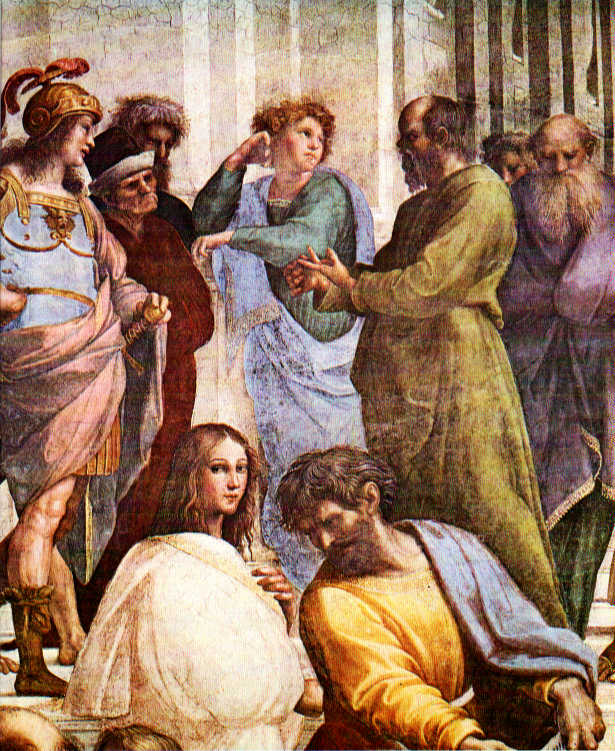
Image credits: Manuscript of Sughrat (Socrates) from a 13th century Seljuk illustrator. Currently kept at Topkapi Palace Library, Istanbul, Turkey; Socrates lecturing, from Raphael's School of Athens, Stanza dei Conservatori, Vatican. Both from Wikimedia Commons.

Thursday, September 25, 2008

Slouching toward Revolution

I’ve probably mentioned environmentalist and educator David Orr in other posts on another blog, but as I was scooting though my bookmarks looking for something else, I happened on an essay he wrote in 1991 for a special issue of In Context, A Quarterly of Humane Sustainable Culture, and reprinted online in 1996. Orr's article called "What is Education For? Six myths about the foundations of modern education and six new principles to replace them," and it appears in the the issue on The Learning Revolution: Education Innovations for Global Citizens. Although I don't agree with every author of every article, the issue provides interesting insights into the educational climate of the emerging global economy at the turn of the twenty-first century.

This is the situation the editors described seventeen years ago:

It takes only a glance at the newsstands to know that education is in deep trouble. In France, 250,000 students recently took to the streets to protest unsafe conditions and reduced education budgets. In the U.S., public schools in some parts of the country are being all but abandoned by those who can afford private alternatives. And around the world, education - preparing the next generation to lead productive and fulfilling lives - too often suffers from being on the short end of a dwindling resource stream.

Sound familiar? The editors then envisioned a revolution in learning that could meet the demands of a changing world; it wouldn't necessarily involve a huge economic investment in technology, but rather "a shift in the way we understand what it means to learn and to teach" and changes in "our ideas about learning."

The hope reflected in these articles, including Orr's, is palpable, and is grounded in a move away from long-held beliefs not only about education, but about economy in general. Education becomes not merely a means to becoming rich and famous, but toward something much more important and (the essays suggest) fulfilling.

But learning for what? We are already far too skilled in exploiting the Earth for human ends, yet we are still terribly ignorant about the real basics of life - how to live sustainably on this planet, and in peace with each other. So whether you consider yourself an educator, a learner, or a concerned citizen, this issue is for you; for if the insights and technologies gathered here were put to the service of healing our societies and the planet's life systems, they would spark a revolution of enormous - and beautiful - proportions. We hope you'll participate in making that vision a reality.

Needless to say, the revolution never seems to have arrived. What Alan AtKisson describes in his introductory essay is still very much the case:

We are in a time when the destructive power of our ignorance is casting cold shadows across our knowledge - and the integrity of many species, cultures, and natural systems is being eclipsed in the process.

David Orr's response (from a commencement address he delivered in 1990) remains current, and his observations could have been taken from this morning's headlines:

The truth is that many things on which your future health and prosperity depend are in dire jeopardy: climate stability, the resilience and productivity of natural systems, the beauty of the natural world, and biological diversity.

Add to this a rapidly failing economy here in the United States (which promises to engulf much of the rest of the world unless it's properly addressed), and then make note, as Orr does, of the fact that these crises were not effected by uneducated people. The environmental and economic "challenges" (to use a word popular in educational circles today) have been wrought by a particular kind of ignorance against which our current forms of education do not insulate us.

People actually seem to be twigging to the idea that book-learning is not in itself the sole source of experience and wisdom. I can't help but blame the popularity of self-proclaimed populists like John McCain and Sarah Palin (and even George Bush) on the perception that those ivory-tower elites have gotten us into this mess (even if they were Conservative elites, they were still from Yale and Harvard). Never mind that we've had eight years of folksy leadership from a guy who was elected in part because he was the kind of fella you'd like to have a beer with, and we're considerably worse off as a result. It's the perception that counts, and it dogs candidates like Harvard-grad Barack Obama, who gets advice from pundits to "dumb it down." (I actually heard a commentator suggest this on Hardball the other night.)

It is rather ironic that some of our problems are actually grounded in knowledge, or at least in our tendency to read philosophy uncritically. Orr points to Francis Bacon, Galileo, and Descartes as sources for our traditional separation of human beings from the natural world--and notes that these are the foundations of modern educational theory, "foundations now enshrined in myths we have come to accept without question." He goes on to discuss six: Ignorance is a solvable problem; with enough knowledge and technology we can manage planet Earth; knowledge is increasing and by implication human goodness; we can adequately restore that which we have dismantled; the purpose of education is that of giving you the means for upward mobility and success; and our culture represents the pinnacle of human achievement. His careful explication of each of these presumptions is worth reading and considering.

Even though the revolution he was advocating in the '90s still hasn't occurred nearly twenty years later doesn't mean that the solutions he poses aren't still possible or necessary. The six principles he considers as solutions include these: All education is environmental education; the goal of education is not mastery of subject matter, but of one's person (from the Greek notion of paideia); knowledge carries with it the responsibility to see that it is well used in the world; we cannot say that we know something until we understand the effects of this knowledge on real people and their communities; "minute particulars" and the power of examples over words are important (my variation on this principle is "you are what you do," and because we are by nature metaphor makers, example carries enormous weight); and the way learning occurs is as important as the content of particular courses.

I'm doing Orr an injustice by simply listing his problems and solutions. But I hope that by doing so, I will pique my readers' interest strongly enough for them to engage in a careful reading of his essay. And then, for homework, go on to read his book The Nature of Design: Ecology, Culture, and Human Intention. It's an education in itself.

Photo credit: The abandoned Granger elementary school in Tucumcari, New Mexico, by Wordbuilder. Wikimedia Commons.

Thursday, September 18, 2008

Education in the Kitchen

Sometimes parents seem to abandon common sense when it comes to feeding their children. In this country, for example, and in a growing number of developing countries throughout the world, breastfeeding is sadly not necessarily the first choice for feeding infants. In China, the increasing number of babies fed with formula has led to yet another food-contamination crisis--this time over formula tainted with melamine.

The inability to nurse a newborn is rare in cultures where breastfeeding is seen as appropriate, natural, and preferred, and where mothers have the unstinting support of their physicians, nurses, families, and communities. And while it's true that breastfeeding is on the rise in the United States, mothers still only nurse for a few months and are then anxious to wean their kids to solid foods, usually those promoted most heavily by Big Baby Food--even though breastfeeding exclusively for five months or so, and then very gradually introducing other foods, helps curb obesity and food allergies. (Statistics on the advantages, prevalence, and duration of breastfeeding in the U. S. are available through the Centers for Disease Control and through La Leche League International.)

What brought all this to mind, in addition to the increasingly alarming news from China, was an article in last Sunday's New York Times: Six Food Mistakes that Parents Make, by Tara Parker-Pope. In it she tells of a child whose preschool diet consisted of chocolate-laced "meals" of all varieties (just as some friends of ours once fed their daughter pizza almost exclusively)--because that's all he would eat. It turns out to be easier to feed your kids whatever they want in the interest of feeding them something rather than nothing.

Having picky eaters at all is, of course, a reflection of an affluent society with an overabundance of choices. Starving children eat anything they can; only the rich have children who demand chocolate for breakfast. But almost every parent experiences some degree of food-fussiness, and Parker-Hope's article is full of great suggestions on how to avoid conflicts.

Most of the advice is common sense, however, and if we were less concerned with just getting our kids to eat, and more concerned about what we're teaching them about the role of food in their lives, we'd probably have healthier, less demanding children. Of course, they'd have less fun manipulating their parents, too--but I think it would be far more enjoyable to interact with kids by teaching them how to choose and prepare foods wisely than by trying to force them into patterns that can lead to decidedly unhealthful ways of viewing food in general.

For example, kids--like all human beings--are metaphor makers. If we tell them to eat one way, but eat another ourselves, they arrive at an inevitable conclusion: my mother's a liar. By following the diet du jour, but insisting that our children eat something different (a more "balanced" meal while we have at the Atkins packaged dinners), we're falling into the old "do what I say, not what I do" trap, which has no consequence other than to make parents look as if they have no control over themselves.

My own biggest mistake was not being more generous in the kitchen; I tended to see it as my own domain, and seldom encouraged my kids to cook with me. Another was to follow a highly restricted diet, albeit for ethical and religious reasons. While my children were growing up I was a vegetarian; not only that, I kept a Kosher home, which further restricted the types of cheese and other products I bought for home consumption. I did have the good sense to pretty much let the children eat whatever they wanted outside of the house, but I knew the jig was up when they started hanging over the meat counter at the grocery store, drooling longingly over the steaks.

The compromise was happy chickens. I had abstained from meat not because I thought there was something morally wrong with eating it, but because I couldn't take the responsibility for killing it myself and therefore thought I had no right to eat it. The Kosher part was for community; I wanted any friends of any degree of Jewishness (or Gentility, as it were) to be able to eat at my table. Eventually, however, I realized that I could serve cold vegetable meals on glass plates to my Orthodox friends, and buy organic, free-range meat without suffering too much guilt. By that time, however, my children's habits were firmly in place, and I'll have to wait for grandchildren in order to do it right.

But anyone with small children can use mealtime as a teaching and learning experience, and not just about food. Maths can be taught through baking; history and geography can sneak into a meal based on a particular ethnic cuisine; even films and literature can provide foundations for a meal--through books like The Joyce of Cooking, the Nero Wolfe Cookbook, and It Came From the Kitchen. Art history's a natural: try constructing a meal based on a painting, or dive into recipes from one of the many artists who loved food: Vincent van Gogh, Frida Kahlo, Claude Monet.

Common-sense eating can easily become part of a natural education: from the growing of food to understanding its history and culture. For background, parents can consult websites like The Food Timeline, Betty Fussel's, The Story of Corn, H. E. Jacob's Six Thousand Years of Bread. And then there are the likes of The Philosopher's Kitchen (Recipes from Ancient Greece and Rome for the Modern Cook) by Francine Segan (who also wrote Movie Menus and Shakespeare's Kitchen), Jean Bottéro's The Oldest Cuisine in the World: Cooking in Mesopotamia, and James Davidson's Courtesans and Fishcakes: The Consuming Passions of Classical Athens (the link to the latter is to its first chapter). Simply having books like these on the shelves of one's house can prompt discussions about food, history, nutrition, culture, science, and any number of topics among parents and children.

Parker-Pope notes in her article that the more kids are involved in food preparation, the more likely they are to eat what they make, not only at home, but elsewhere. I can't think of a more powerful schoolroom, in fact, than a kitchen in which children are welcome, and a garden in which children help to grow what they eat. Home-schoolers have a wonderful opportunity to integrate all manner of learning while simply caring for home and hearth; but even kids in traditional schools can reap enormous benefits from being included in meal-planning and preparation, and from accompanying their parents to grocery stores and/or farmer's markets to help select the food they'll eventually eat.

As it turns out, cooking and eating provide not only the basic framework for survival in the world, but for learning about it as well. Think of how much smarter we'd all be if we actually mastered the skills necessary to plant, harvest, prepare, and cook most of what we eat--just like our pioneer ancestors had to. Sharing food among family and friends grounds community, and offers a deeply resonant metaphor for living, teaching, and learning well.

Images: A Helping Hand, by Eugen von Blaas, 1884; Mary Cassatt, Maternité, 1890. Both from Wikimedia Commons.