Showing posts with label metaphor. Show all posts

Tuesday, December 1, 2009

Bread and Circuses

The conflict between privacy and celebrity has finally reached the point of pure idiocy. Actually, it already had, but the recent flap concerning Tiger Woods (who has actually earned his fame) points to the absurdity with which modern media attend to matters that would once have been purely private.

I don't know why Woods slammed into a tree in the middle of the night. And unless it somehow affects national security (as the also-recent flap concerning party crashers at the White House might), I'm content to keep my nose where it belongs. In my own business.

But prurient interest in what goes on in other people's houses seems to have become an international pastime. Witness the tragicomic antics of the "new" royal family in Britain, where the intensity of this kind of curiosity seems to have ramped up, and of which I was reminded last night as we watched Helen Mirren's performance as Elizabeth II in Stephen Frears's film The Queen. Never having met QEII herself, I can only judge the acting job superficially, but I was completely taken in by the compelling portrayal of a woman caught between the worlds of restrained tradition and media frenzy.

Queen Elizabeth's initial reaction to Princess Diana's death seems to have been that even though Diana was a public figure, her funeral should be private (there were, after all, children involved here). But nobody in the public eye--especially anyone who has played the public for sympathy (whether deserved or not)--gets privacy any more. The outpouring of grief over Diana's death fueled tabloid hysteria almost to the point of conflagration, as if the papers and television realized that they were losing a cash cow and had to wring out every byline and lurid headline before the furor itself died out.

Nowadays, celebrity is being sought for its own sake. Andy Warhole's fifteen minutes of fame idea has become a life-goal for some people. Substance and accomplishment are no longer criteria of fame. Instead, publicity seems to be the sole measure: whoever can garner the most coverage becomes the news item du jour.

All this is one more indication of the shallowing (probably not a word) of the cultural pool of metaphor. No longer deepening through shared experience, interesting connections, or intellectual freshness, the pool of which I frequently speak is just plain drying up. Metaphors are becoming predictable and stale (like the fifteen minutes of fame quip itself), and even the word "like" (which used to signal an upcoming comparison) has become a vocal mannerism equivalent to "uh" or "you know."

The only still-rich sources of metaphor seem to be science and technology, but even these are turning out tropes based on the rampant growth of social media. So "tweet" and "twitter" no longer refer to sounds made by birds, but rather to noises made by people seeking fame in cyberspace. Science contributes to new words that refer to increasingly short attention spans: nanosecond and (frequently used inappropriately) quantum leap. A quantum is actually really tiny ("quantum theory deals with the tiniest things we know, the particles that atoms are made of"), rather like the brains of those who seem to be operating the news media these days. Ahem.

I don't really want to belabor my point (because, as you know, I tend to go on and on about things), but I do so miss the days when I didn't really know anything about the lives of those making the news. In fact, all I really care about Tiger Woods is how he plays golf. Although I appreciate the example he has been setting for young people, I'm not going to be using any sports figure as an example when it comes to raising children--unless, of course, that sports figure also turns out to be a Rhodes Scholar or a brilliant scientist or an inspiring teacher as well.

Metaphor is about complexity; the more we know, the more creative the connections we can make. Perhaps now is the time for us to turn off our television sets and bake our own bread. Who knows what would happen if we taught our kids to notice what happens when raisin bread rises, rather than what the latest talentless nincompoop is doing in the latest media circus.

Image credit: Henryk Siemiradzki, A Christian Dirce, nineteenth century. The painting depicts Nero with an executed Christian woman in his circus (Wikimedia Commons). Comparisons of current cultural events and those of imperial Rome are commonplace these days, but not inappropriate. For more on this topic, see Cullen Murphy's recent book, Are We Rome?

Wednesday, October 14, 2009

Metaphors Be With You

I usually start the quarter out talking about the necessity of metaphor in the learning process, but the manifold uses of metaphor and translation in everyday life have been popping up everywhere, prompting this post.

As some of you already know, I'm not an enormous fan of "self help" culture or new-agey spiritual quests, but every now and then I come across a book that falls into one or both of these categories and that proves both useful and interesting. One, Michael Gelb's How to Think Like Leonardo da Vinci, is especially helpful in teaching my students about the importance of making connections (connessione) and embracing ambiguity (sfumato) in the development of creativity. It's so useful, in fact, that I carry it around on my cart (portable office) from class to class, and more than one student has been inspired to check it out of the library.

More recently I happened on Norman Fischer's Sailing Home: Using the Wisdom of Homer's Odyssey to Navigate Life's Perils and Pitfalls (New York: Free Press, 2008), which was on the cheap deal rack at Borders. Always on the lookout for material my students can use for research on their illuminated manuscript project (the "Lotus Eaters" episode in The Odyssey is one of their choices), I thumbed through it and what little I read I found rather engaging. Fischer is a Buddhist monk, and my long association with the East has made me more sympathetic to Buddhists than to most established religions (I've actually know some pretty cool Buddhists who used to hang out with the Benedictine priests we visited in mountain missions in Taiwan). So I bought it. At three bucks it was cheap at twice the price (as the old saw goes).

While reading through the first chapter, "The Sea of Stories," I found Fischer's treatment of metaphor and its value to storytelling insightful and potentially useful. As he points out, "Creating, processing, and interpreting stories is a major industry" (13), and my students are some of that industry's future purveyors. They're taking my classes in order to help them become better storytellers. In his introduction, Fischer notes that "metaphors condition, far more than we realize, the way we think about ourselves and our world, and therefore the way we are and act" (7), and thus significantly influence the kinds of stories we tell, and our ability to tell them creatively.

As I've mentioned elsewhere on this blog, I'm fond of Gerald Holton's concept of the "cultural pool of metaphor" from which we draw images and ideas that have collected through the cultural experiences of ourselves and our ancestors. And my students probably get tired of hearing me say that "the more you know, the more you can know," because the more you know, the more metaphors you absorb, and the more lenses you have through which to interpret the world. The lens Fischer offers in his book asks us to look at an odyssey as a journey--not a quest, but a journey home. Students who come to understand that metaphor not only know Homer's world better, but can in turn (in Fischer's view) apply that understanding to their own world.

Not long after I finished the first chapter of Sailing Home, and sat down to work, I remembered that I was supposed to look up the word that refers to the human tendency to see patterns where they don't necessarily exist. I found it in the Skeptic's Dictionary: pareidolia, from the Greek para (beside) and eidos (image). It's the phenomenon that encourages people to see faces on Mars and Jesus in tortillas, and has people running to see the Virgin's image in a tree trunk. It's actually an aspect of metaphorical thinking, at least in Gregory Bateson's sense of "seeing as." Since Bateson was a psychologist as well as an anthropologist, it makes sense that he would recognize metaphor as the basis of some psychological practices and processes--like using the Rorschach test.

Pareidolia may also be at the root of some cave paintings, like the "Wounded" or "Leaping" bison from Altamira Cave, where cracks and contours on the cave wall may have suggested the positions of some of the figures. When we look up at the clouds like Opal and Earl (in one of my favorite comic strips, Pickles) or the folks in Strange Brew or Red and Rover and imagine seeing images of animals or other miscellaneous items, we're engaging in metaphor-making on a very basic level.

Parody is another example of "seeing as" and also an example of Terry Barrett's adage that "All art is in part about other art." Being able to see Michelangelo's David in a pair of Calvin Klein Jeans is pretty silly--but it probably could sell the jeans because David is a pretty fair model of a man (another metaphorical construct), as any giggly high school girl in Florence can tell you. I used to have my students produce parodies of famous art works--that is, at least, until I got one too many "booty call" renditions of Ingres's Grande Odalisque. Various artists have created major works that parody those of others, such as Picasso's play on Velasquez's Las Meninas.

Metaphor is such a basic aspect of human intellectual experience that I can't imagine creativity operating without it. Unfortunately, reduced to its most banal, metaphor becomes cliché, and loses its instructive and inspirational energy. But as long as we keep encouraging our students to learn more for the sake of learning, and to expand their storytelling horizons by filling up that cultural pool with new, inventive, different, meaningful, and invigorating metaphors, we'll be doing them and ourselves an enormous favor.

Image Source: "Nausicaa Playing Ball with her Maidens," one of John Flaxman's illustrations for the 1810 edition of The Odyssey. I chose this one because it illustrates the moment when Odysseus begins the final leg of his journey home and entertains Nausicaa's parents with stories of his adventures. It's also the segment of the story that inspired the opening scene for More News From Nowhere. I cleaned the image up a little, but got it from Wikimedia Commons. Fittingly enough, Athena herself appears, floating behind the young women.

A note on the title of this post: I stole it from a bumper sticker.

Thursday, April 30, 2009

Losing Language, Losing Meaning

In my first outing post-surgery (after being told by my surgeon that I was well on the mend and good to go for driving, fewer than three weeks from the day he cracked my chest), my daughter and I celebrated at Starbucks and then headed for Half Price Books. I always look in the nature writers and science fiction sections first, and was rewarded on both counts. The best find was Ursula LeGuin's Lavinia, a story based on the last part of Vergil's Aeneid, and on a woman (Aeneas's "native" wife) barely mentioned in the poem. But no one is better at imagining worlds not her own than Ursula K. LeGuin, and I snatched the book up in a nonce. Well, maybe two nonces (you'd have to be a fan of A Funny Thing Happened on the Way to the Forum to get that one). Please note that the owl is only a coincidence.

LeGuin's opening remarks lament the loss of Latin, and the fact that it won't be long before nobody will be reading Vergil in the original. Already I have to explain to my students who Vergil was and why Dante would be following him around in the Divine Comedy. My own Latin is barely functional; I learnt what I know only because it was required of a Greek major at U.C. Riverside, but I can find my way through the geography of grammar and syntax with the help of a primer and a dictionary. But I know exactly what she means. These languages are on their way to the cultural dustbin and will soon become the sole purview of wizened scholars and other odd folk.

If only we knew what we were losing! If only today's students understood how much richer their own language and their lives would be were they supplemented by the words and wisdom of the ancient world (people who already made the mistakes we're in the process of making now). But even the basic etymologies of English words are becoming lost to them. They no longer care or are even vaguely interested in why our words are shaped the way they are. They not only don't know what "sanguine" means, but they're not even aware of its subtleties: it can mean both optimistic and bloody (as the character Zoe points out in an episode of Firefly; but that show was canceled, so there goes another ed-op).

Speaking of blood, which is actually where all this is headed, I'm now a member of a very large community of people dependent on the drug Coumadin (generic name Warfarin), an anticoagulant that will keep my blood flowing freely through my shiny new mechanical aortic valve. Unfortunately, these drugs also suffer from lost language and bad metaphor, because they are commonly known as "blood thinners." But they don't thin the blood at all; that's simply somebody's lame attempt at helping the dumb and dumberer understand what "anticoagulation" means, without simply pointing out the etymology of the term: "anti" = "against"; "coagulate" (from the Latin coagulare, to curdle) = clot; hence a usable definition as "prevention of clotting." It has nothing to do with the "thickness" of blood, but apparently people have less trouble with inappropriate metaphors (they can understand thick and thin better than clot-prevention for some reason) than they do with knowing that a word was derived from a more useful metaphor: the curdling process involved in cheese-making. (It occurs to me, as an afterthought, that most people know longer know much about how cheese is made, so perhaps that's the reason for the bad metaphor.)

So better metaphors are out there; after all, it would be quite simple to understand that you want the consistency of your blood to be like single curds flowing freely in whey than like mozzarella! Or, for that matter, to keep the consistency balanced so that it isn't entirely whey and certainly doesn't become even as dense as ricotta. The "whey" would represent the condition (not thickness) that might generate free bleeding (the absence of clotting), and the flow of curds through whey as having the potential to clot when necessary (so you don't bleed to death), but not clot so easily that the offending conglomerations would jam up and cause a stroke. "Thick" vs. "thin" is not only simple, it's simplistic; it doesn't even come close to describing the process.

In the world of tweets and twitters and twits, there's no room for the subtle--especially if it takes up more characters (anticoagulation =15; "blood thinning" = 13, not counting the space). Also, if you don't know anything about language, you have to look the word up in a good dictionary. How many folks even own one any more?

Where does this leave us? Not in a happy place, I think. Several years ago I began to notice that students were becoming less and less able to identify where artists were from by looking at their names. They can no longer tell that Leonardo or Michelangelo are Italian, that Chardin and Watteau are French, that van der Weyden is Dutch, and that Turner is English. They can't identify a Russian or a Greek name without being told where the artist is from. They're better at Spanish names, and Arabic, which makes sense, but they've lost everything else unless they've studied a language in high school (no longer a requirement for graduation, or if it is, they just take Spanish by default) or have parents or relatives from other parts of the world. Asian names seem to be recognizable in general, but not those from specific countries (they can't tell Korean from Japanese from Chinese). I attribute this vague familiarity to manga, anime, and video games, which tend to be only vaguely Asian and not ethnically specific.

While I was still in hospital, the fulcrum of multiculturalism in otherwise xenophobic America, I played a game, at which I ended up batting about .850: guessing staff-members' nationalities by their names. I missed one, because his surname (Tan) was a remnant of the Chinese in his ancestry, but all of his immediate family were Philippino. I guessed Chinese, of course--even though he didn't look it (the Philippines have a more varied ethnic background, including European and native islander, than most Chinese do, and it shows in their physiognomy). I also spent three of five years in Taiwan being educated by Philippina nuns, so I've had a lot of experience with both. At any rate, I caught the Thais, the Vietnamese, the Chinese, and even (sort of) the Danish Colombian gas-passer who ministered to me during surgery. I guessed Swedish, but he forgave me.

Video games and anime have done their part in spurring some students to learn some Japanese, and sometimes Chinese, but there's less of an interest in European languages, seemingly because "they all speak English." Meanwhile, the State Department, the armed forces, and the CIA are on constant vigil for speakers of Arabic, Farsi, African dialects, and even French, German, and Russian--but I'm pretty sure they end up having to train most of their promising candidates in specific languages.

The only spark of hope in the current situation is the increasing evidence on language and aging. Studies indicate that acquiring a second or third language engages one's brain and helps to sustain cognitive function. This doesn't make much sense to a twenty-year old, but if you're my age (and in danger of stroking out if you don't take your meds properly), any such news is good news.

Now, where did I shelve that Latin grammar?

Image credits: Æneas lands on the shores of Latium with his son Ascanius behind him; on the left, a sow tells him where to found his city. (Lavinia's father was the king of Latium.) British Museum. Roman marble relief, CE 140-150. Copyright Marie-Lan Nguyen/Wikimedia Commons.

Thursday, October 2, 2008

The End of Metaphor?

Before tonight's debate, which I probably won't watch (it's really hard on my blood pressure; instead, I read transcripts the next day. I do, however, occasionally watch with the sound off to see what body language looks like), I decided to get something off my chest. So far I've hesitated to blog roughshod into politics because some of my best and most beloved friends and family espouse views that differ significantly from mine. In truth, despite my often apparent "leftiness," I'm a fairly conservative person--in terms of family values, hearth, home, all that stuff. And despite my fairly radical anti-capitalism (at least capitalism as it has emerged since the Industrial Revolution), I have a lot of views that folks might think of as pretty conservative.

One of these concerns the idea of democracy. I think, in essence, that Socrates and Plato were right. Democracy doesn't work unless the populace that practices it is educated; otherwise you get mob rule. A person can't get a whole lot more conservative than siding with an ancient Greek dead white guy.

Today, of course, participation in governance is the birthright of every citizen in this country and in other modern democracies and social democracies. Citizenship entails responsibilities as well as rights--which is as it should be--although many seem to forget the responsibility part in the heat of political campaigns.

At any rate, at the risk of offending all sorts of people, I'm going to go out on a limb here and tell you why I think John McCain and (even more so) Sarah Palin are not good prospects for leaders in a modern democracy--especially one trying to maintain a place of power and prominence in an increasingly global economy.

It has to do with metaphor. Human beings, whom I like to refer to (as a species) as homo translator (man the translator, or metaphor-maker), rely on metaphorical thinking. As I've noted previously, there are two basic ways human beings learn stuff: by hearsay and by experience (Socrates develops these two varieties of education in The Republic). We learn when people tell us stories about what they and our ancestors have done, and we learn by doing things ourselves (remember chemistry lab?). Both of these ways of learning provide us with examples from which we can extrapolate ideas and apply them to new situations. Both similarities to and differences from other situations (ones we're more familiar with) help us to understand what's going on.

The value of formal education is that it expands our repertoir of examples by encouraging us to learn many more stories than we get locally (from family and friends, and in our own time). These stories add to our "cultural pool of metaphor" (the term comes from Gerald Holton) by including information from a much vaster range of people and from a much broader temporal spectrum than we could ever actually experience. We couple those stories with our own "local" learning and experience to gain a more broadly-based, richer education. I won't go as far as Plato and Socrates in saying that popular knowledge doesn't really count; but I will say that book-learning and wider exposure to the world prepare leaders better than does hanging around at the local saloon, drinking a Bud Light. Not that pub-crawling isn't good for philosophy; without the taverns in Edinburgh, the Scottish Enlightenment might never have happened, and Adam Smith might never have written The Wealth of Nations.

As I was saying, these combined modes of learning form the foundation for the kind of education needed to run a democracy. If some people have vastly diminished learning resources, they can't participate as completely or as well. And this is one of the abiding difficulties facing modern democracy: making sure every citizen has the opportunity to become well educated and to participate in governing his or her country.

The word "populist" has recently exploded into our common vocabulary to describe a particular kind of political candidate. It's gone beyond an earlier description of someone who rises from the working or middle classes and represents the concerns of most citizens. Very recently it has come to refer to someone who's not only not a political insider, but also not an "elitist." Populists of this description don't necessarily have much of an education, but can draw on even fairly restricted experience because they "know what it's like" to be an average Joe, to be like "everyman" (or "everywoman"). They don't have to know about tough subjects like economics, because they'll have people to advise them.

So a few questions begin to emerge: if you don't know much about a subject like economics, how are you going to evaluate the advice you're given? If you have no grounding in international relations and understand little about other cultures, how are you going to know if somebody's selling you a bill of goods when his or her advice is to wage war? If you're not conversant with the fundamentals of capitalism, how are you going to negotiate the nuances of the horrifically complex system that has emerged in the last century, and is now compounded by the reality of globalization? If you don't understand basic environmental science, how can you govern in a time of climatic crisis?

As I listen to Sarah Palin stumble around questions in interviews, it becomes clear that she is just not very well educated. She does seem to have plenty of street smarts, and good local political instincts (because she is just like the people she governs in Alaska). Her pool of metaphor is adequate for people who have a passel of kids, drive snow mobiles, work on pipelines, play hockey, and shoot moose (or wolves). But most of the world shares only one or two of these experiences; it's clear, for example, that aside from child-rearing she shares little enough with me. Palin's metaphors are primarily local and extremely hackneyed. She lacks the historical and cultural background that true world leaders need simply to hold a conversation with one another for longer than a brief introduction at the UN. Her entire candidacy is based on strongly held, inflexible religious and political views, and severely limited experience of the world.

John McCain, on the other hand, has both education and experience on his side. Being a graduate of Annapolis ensures a young Naval officer of a solid academic background, albeit one focused on what makes a good military man (and although he graduated near the bottom of his class). A significant chunk of his experience, however, comes from his incarceration in Vietnam, and very few of the rest of us share anything like it. We have no way of knowing how it colored his understanding of the world. His time in prison also looms so large in his life that it seems to have become the central defining metaphor for every other experience. And when I listen to him debate and participate in interviews, seldom do I not hear a reference, either open or oblique, to what he endured and what it taught him. As horrific and impossible for the rest of us to truly understand as it was, it happened half a lifetime ago. His experiences since that time, however, take a back seat to that single, all-consuming narrative.

Because of his less-then-stellar academic record, McCain's educational credentials don't make him susceptible to complaints about elitism. He doesn't have to apologize for an Ivy League education or for a reputation as a thinker. In that, he and Palin share a populist pulpit from which they can make fun of deliberation and intellectualism, and brag about making decisions with their guts or without blinking. And this is precisely where I have a problem.

The careful thinking-through of problems that comes with broad experience is a quality I would like to see in someone who works next to a red telephone and has a button within reach. I do not want somebody who reacts with his or her guts rather than his or her brains. And I want as leaders people who have enough cultural experience to include books like John Hersey's Hiroshima, Herman Wouk's The Winds of War, and films like Seven Days In May and Dr. Strangelove in their library of metaphors.

When we begin to denigrate our public intellectuals and to decry intellectualism as elitism, we are also sending a message that does every child in this country a disservice. When we make fun of smart people, but make our kids suffer the indignities of today's public schools--and then tell them that they have to go to college--we're sending them a very mixed message.

Unless we start electing people with the intellectual substance to solve our economic problems and rebuild our reputation among other world leaders and their constituencies, and until we have a president who's smart enough to evaluate evidence carefully and honestly, we'll continue on the path laid down over the last eight years. And without fresh, complex, vibrant metaphors and examples on which to model an alternative future, there's little hope that things will get better any time soon.

On a conciliatory note, if anyone's still with me after this rant, I'll end with a apt quotation from Editorial Anonymous (a blog on publishing children's books), which sums up my view of party politics:

. . . I don't mind what party people align themselves with. The nice thing about book people is that they're thinking people, and as long as you're thinking, you get to vote however you want. The people who drive me crazy are the ones who vote "from their gut". . . . Thinking people like to talk civilly and intelligently about issues, and as long as you're ready to do that, you're in the club.

A post-debate update, 3 October: I did watch it. And I haven't changed my mind. The main difficulty as I see it is that Palin didn't answer the questions posed; she gave speeches. She also winked and looked cute and tried hard to be folksy. She even asked if she could call Senator Biden "Joe" (he referred to her throughout as "Governor Palin" or "the governor"), so although the exchange was civil and even friendly, it lacked decorum. I'm glad she didn't embarrass herself, and it's clear that she's a quick study. But I'm still convinced that her time has not yet come.

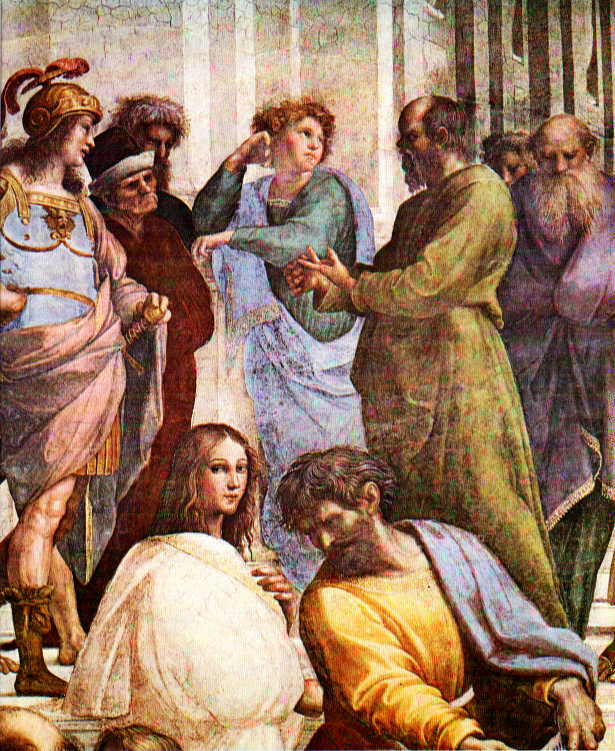
Image credits: Manuscript of Sughrat (Socrates) from a 13th century Seljuk illustrator. Currently kept at Topkapi Palace Library, Istanbul, Turkey; Socrates lecturing, from Raphael's School of Athens, Stanza dei Conservatori, Vatican. Both from Wikimedia Commons.