Showing posts with label technology. Show all posts

Sunday, January 31, 2010

Hooked Into Machine

I'm not terrifically fond of popular music, but I do rather like Regina Spektor, the irreverant young songwriter/singer/pianist whose latest album, Far, has helped me get to work lately. Her stuff is witty and melodic, with odd jazzy/bluesy vocal riffs, and some amusing social commentary.

One of the songs gives this post its title, and my riff is on the currently popular propensity to stay constantly plugged in to one machine or another--and sometimes many. In many ways this phenomenon is connected to some of my remarks in The Multitasking Myth from some weeks back. It's undoubtedly also connected to the huge (and growing) number of ADHD diagnoses being thrown around, but that's for another day, and another rant.

In "Eet," Spektor touches another of my nerves with the lines,

you spent half of your life
trying to fall behind

your ears in your headphones, to drown out your mind


--yet she's far more sanguine than I, as she notes at the end of "Machine":

and you live in the future
and the future
it's here, it's bright, it's now

Of course, I live in the future of which I was terribly afraid as a child. I am, after all, part of that post-war generation that practiced "duck and cover" and (because I lived in Japan in the early fifties) air raid drills. When we lived on base we kept a packed suitcase under each bed, and when the sirens went off, we grabbed them and headed down to the basement of the concrete GI housing complex ("Green Park" it was called, rather ironically).

This probably accounts for my chronic suspicion in regard to technology in general, even though I haven't always been quite so reluctant to adopt new gadgets. My aunt bought me a little turquoise transistor radio for $5.99 in 1964, and I still have it. It was my lifeline to California during my first Texas exile; occasionally, late at night, I could get KRLA if the bounce was right; if not, KOMA, from Oklahoma City played much the same kind of music. I wasn't nearly as much of a music snob then as I am now, and the surfer rock played continuously, ever reminding me that I was really far from any ocean. I did not, however, own a set of headphones.

We also didn't watch much TV when I was growing up, even when there was one in the house. And my daughter was a year old before I bought my first color television set, all 13 inches of it, in 1980, so I could watch Cosmos and she could watch Sesame Street in color. I'm pretty sure we had a computer (a Commodore 64 first, and then an IBM clone, called a Clone) before we ever got a bigger TV. I was only peripherally aware of the possibilities offered by computers, but my first gig as a teaching assistant was in the microcomputer center at UTD, tending to early PCs and Mac SEs. Even my first teaching job at the Art Institute was using Apple 2Es to teach computer literacy.

What being around my children taught me, however, was to be selective about my technologies, because I saw how fast kids latch on to things, without questioning their real necessity or even utility. Children are little information siphons, and anything new that feeds them data (no matter what kind) is on that year's birthday or Christmas wish list. I am to this moment grateful beyond measure for the fact that cellular phones were not widely available in this country while my children were growing up.

These days I have to practically beg my students to disconnect for an hour and a half. Despite the fact that electronic devices of any sort are prohibited in the classroom, I constantly catch them sneaking peeks at their phones or even texting under the desk, oblivious to the fact that their very body language gives them away. Occasionally I'll make fun of them for trying to pull one over on me, but usually I just let it go. The real problem isn't just the lack of social graces and courtesy these little acts of rebellion demonstrate; it's the sense of quiet desperation reflected in the fact that they just can't turn the damned things off for even a few minutes.

It really is almost as though they're afraid to listen to themselves think.

Plugged relentlessly into headphones attached to their iPods or iPhones, they don't seem to be able to live without a soundtrack. Silence seems to scare the crap out of them. And why shouldn't it? They probably grew up with TVs on all the time, or tape players and radios and CDs in the car, computer games going night and day, Muzak in every store. I wonder how many members of generation X or Y have actually ever heard silence.

Even now, sitting at my desk on a Sunday afternoon in a quiet house, the furnace is going, the cars drive by, the ridiculous recorded church bells from nearly a mile away are tolling. The one truly pleasant sound is the occasional snore from one of the dogs.

This morning I was reading a book I bought yesterday, Land Arts of the American West by Chris Taylor and Bill Gilbert. It's a compendium of images and text resulting from a project involving the College of Fine Arts at the University of New Mexico. It's designed, according to the Introduction, to "explore the large array of human responses to a specific landscape over an extended period of time." Some of what it features are works by people I've lectured on in the past--Robert Smithson, James Turrell, Nancy Holt, Michael Heizer, Lucy Lewis's daughters--as well as landscapes of which I am particularly fond--Chaco Canyon, Wupatki, Sunset Crater, and a big chunk of Western desert. The book is stunning and inspiring, and as I was writing this essay I remembered one of the things I love best about these spaces: their silence.

Except for wind and birdsong, there is little in the way of noise out in the middle of nowhere. Sometimes it's so quiet, one can hear the sound of a bug walking across sand, or a lizard skittering across a rock. Sand itself seems, despite the hard surfaces of the grains, to absorb sound into its interstices, muffling the world around it. A thumping great wind can blow up out of nowhere and change all that, but in the end everything goes back to silence.

Yesterday I thought the battery in my iPhone was shot, and I played around with the idea of upgrading to a 3GS (mine is a first-generation 2G). I even mooned around on the Apple website lusting after a MacBook Pro (one of my students let me play with his the other night and I was smitten). In the end, though, the problem turned out to be my car charger, and the battery is working just fine now. So I get to put off the decision a bit longer--like I did with getting the phone in the first place. I've only had it for two years, and I only got it because nobody could reach me when my daughter had to have an emergency appendectomy. So I ended up with a phone not for myself, but to put my family at ease.

Now, of course, I depend on the bloody thing far too much; but it helps me keep in touch, even though I don't really use it all that frequently. I read the New York Times on it more often than I phone anyone; I've never listened to music on it; I'm not even sure how to use some of the basic apps. So no, I won't be getting an iPad any time soon.

I am, however, still daydreaming about the MacBook Pro.

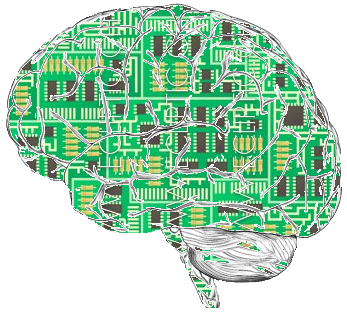
Image credit: Ghengiskanhg, "Artificial Fiction Brain" via Wikimedia Commons.

Tuesday, December 1, 2009

Bread and Circuses

The conflict between privacy and celebrity has finally reached the point of pure idiocy. Actually, it already had, but the recent flap concerning Tiger Woods (who has actually earned his fame) points to the absurdity with which modern media attend to matters that would once have been purely private.

I don't know why Woods slammed into a tree in the middle of the night. And unless it somehow affects national security (as the also-recent flap concerning party crashers at the White House might), I'm content to keep my nose where it belongs. In my own business.

But prurient interest in what goes on in other people's houses seems to have become an international pastime. Witness the tragicomic antics of the "new" royal family in Britain, where the intensity of this kind of curiosity seems to have ramped up, and of which I was reminded last night as we watched Helen Mirren's performance as Elizabeth II in Stephen Frears's film The Queen. Never having met QEII herself, I can only judge the acting job superficially, but I was completely taken in by the compelling portrayal of a woman caught between the worlds of restrained tradition and media frenzy.

Queen Elizabeth's initial reaction to Princess Diana's death seems to have been that even though Diana was a public figure, her funeral should be private (there were, after all, children involved here). But nobody in the public eye--especially anyone who has played the public for sympathy (whether deserved or not)--gets privacy any more. The outpouring of grief over Diana's death fueled tabloid hysteria almost to the point of conflagration, as if the papers and television realized that they were losing a cash cow and had to wring out every byline and lurid headline before the furor itself died out.

Nowadays, celebrity is being sought for its own sake. Andy Warhole's fifteen minutes of fame idea has become a life-goal for some people. Substance and accomplishment are no longer criteria of fame. Instead, publicity seems to be the sole measure: whoever can garner the most coverage becomes the news item du jour.

All this is one more indication of the shallowing (probably not a word) of the cultural pool of metaphor. No longer deepening through shared experience, interesting connections, or intellectual freshness, the pool of which I frequently speak is just plain drying up. Metaphors are becoming predictable and stale (like the fifteen minutes of fame quip itself), and even the word "like" (which used to signal an upcoming comparison) has become a vocal mannerism equivalent to "uh" or "you know."

The only still-rich sources of metaphor seem to be science and technology, but even these are turning out tropes based on the rampant growth of social media. So "tweet" and "twitter" no longer refer to sounds made by birds, but rather to noises made by people seeking fame in cyberspace. Science contributes to new words that refer to increasingly short attention spans: nanosecond and (frequently used inappropriately) quantum leap. A quantum is actually really tiny ("quantum theory deals with the tiniest things we know, the particles that atoms are made of"), rather like the brains of those who seem to be operating the news media these days. Ahem.

I don't really want to belabor my point (because, as you know, I tend to go on and on about things), but I do so miss the days when I didn't really know anything about the lives of those making the news. In fact, all I really care about Tiger Woods is how he plays golf. Although I appreciate the example he has been setting for young people, I'm not going to be using any sports figure as an example when it comes to raising children--unless, of course, that sports figure also turns out to be a Rhodes Scholar or a brilliant scientist or an inspiring teacher as well.

Metaphor is about complexity; the more we know, the more creative the connections we can make. Perhaps now is the time for us to turn off our television sets and bake our own bread. Who knows what would happen if we taught our kids to notice what happens when raisin bread rises, rather than what the latest talentless nincompoop is doing in the latest media circus.

Image credit: Henryk Siemiradzki, A Christian Dirce, nineteenth century. The painting depicts Nero with an executed Christian woman in his circus (Wikimedia Commons). Comparisons of current cultural events and those of imperial Rome are commonplace these days, but not inappropriate. For more on this topic, see Cullen Murphy's recent book, Are We Rome?

Sunday, October 25, 2009

Technology and Education--Really Cool Toys

This will probably be an ongoing feature of the Owl of Athena, because I keep happening on items that encourage optimism about the future of education. Such encounters are not as frequent as I'd like in order for me to become generally more sanguine about where we're going, but they do help make up for all the rain we've been having lately, which has damaged some books I had stupidly stored in my garage.

The British Library has applied digital page-turning software to a selection of books in its collection, and the results are stunning: The Luttrell Psalter, the Lindisfarne Gospel (with its bejewelled cover in exquisite detail), one of Leonardo's notebooks, Jane Austen's History of England (written by hand when she was thirteen years old)--and more.

The technology, which allows readers to use a mouse to "turn" the pages, makes it almost like actually performing the act of page-turning, except for the texture of the page itself (which you wouldn't be able to feel anyway, because you'd be wearing cotton gloves if you had the text in front of you). The pages aren't merely visible, either; rotate, magnify, zoom, or move the pages about on the screen, and listen to or read commentary on them. For my History of Art & Design I students, this may well prove a valuable resource, when it comes time to solve the final design problem--creating an illuminated manuscript of your own.

The technology serves not only codices (both right- and left-reading), but volumes, like the Dering Roll, a three-meter long scroll of heraldic devices (featured on the Turning the Pages website). If you can't figure out how to use the icons, the "get help" link supplies clear instructions, and you can minimize the tool bar and otherwise "personalise" your experience as well. Unfortunately, only select pages are featured from the books featured on the British Library site, twenty three at the moment, but each one includes rich examples of what the book contains.

Some aspects seem a little silly--like the 3D option on the menu, which is otherwise helpful because it offers a choice of categories: in case, for example, you're interested in Science and Nature but not in Religious texts. Some of the categories are empty, but provide an idea of what will eventually be available.

Alas, the program currently (in its TTP 2.0 form) only works on PCs running XP or Vista. Some small recompense, perhaps, for those who haven't been completely converted to the Mac cosmos.

The same browser application powers the "Explore the Manuscripts" segment of the English Heritage page on Charles Darwin's home, Down House. Five of Darwin's notebooks are available, and all but the Beagle Diary can be viewed in their entirety.

The folks who made this software possible, Armadillo Systems, have developed it (according to managing director Michael Stocking's blog) to "to help museums and libraries provide access and interpretation for their collections." Since many of us will probably never go abroad again, much less obtain access to the rare book collections of the British Library, I can't think of a more noble cause. I also love the emphasis on interpretation, because that's the engine that drives learning, and the broader our perspective (including encounters with primary texts in their original form), the more fluent the interpretation. Now I just have to drive more of my students toward learning Greek and/or Latin, and I can die happy. Some considerable time in the future, I hope.

Image credit: The first page of Matthew's Gospel, from the Lindisfarne Gospel. Wikimedia Commons. For a much more intimate and true-to-life encounter, go to the British Library link mentioned in the post.