Last week I worked for two hours on a post (using Wordpad, which doesn’t have an automatic backup) before being thwarted by one of Microsoft’s incessant updates to Vista. I was using Wordpad in the first place because I often spend several hours on a post so I don't tend to do it online. But Word embeds so much code that it screws with Blogger’s layouts, so I compose in Wordpad. At any rate, I lost it, and haven’t been back since. But my purpose remained intact, even though I lost steam along with my prose.
The purpose of the original post was to assure anyone who happens upon this blog that, contrary to current popular silliness, the absolutely only thing of any importance scheduled to occur on December 21, 2012, is my sixty-fifth birthday. No, the world is not going to end—not even according to the Maya, misconceptions about whose calendar are at the source of popular culture’s latest charlatan show.
It’s actually a good thing that I didn’t post on this last week for a couple of reasons. The first is that I finally caught up with the November 8 edition of the New York Times’s entertainment section, in which Tyler Gray notes that Roland Emmerich’s film, 2012 (now enjoying huge monetary success and making my job measurably more difficult) isn’t the least bit interested in knowing why the Maya calendar “ends” on this particular date. Gray did the smart thing and interviewed David Stuart (who won a MacArthur “genius” grant when he was eighteen for his already significant work on Mayan language). Stuart points out that December 21, 2012 is simply the end of the latest Baktun and the beginning of the next.
What I don’t understand is why people are so gullible, and why Americans in particular seem to have chosen to be believers rather than scientists. American exceptionalism (the view that we’re special, not only politically and economically, but in the eyes of god) may be at the root of it. After all, the United States exists primarily because it was founded by colonists who wanted to practice religions opposed to or by established churches in the countries from whence they came, and since then politics and religion (though officially separated by a Constitutional clause meant to forestall the establishment of a state religion) have mixed pretty freely. If you're not a professed believer, and preferably a Christian believer, good luck being elected to public office.
But religion doesn’t automatically make one susceptible to goofy claims. The nuns responsible for my early education planted in my nascent brain a love of learning that especially loved learning science. Unfortunately, the more damaging aspect of American-style religion is its tendency to instill doubt in science, unlike mainstream religion in Europe. Recent polls are full of statistics showing that nearly half of Americans think that human beings were created within the last 10,000 years, and claim not to believe in evolution.
The number of people who “believe” in evolution rises significantly as the level of education increases, but asking people if they “believe” in evolution in the first place betrays a fundamental misunderstanding of how science works.
In terms of logic, the problem lies in the fallacy of equivocation: equating two words that mean different things in different contexts. The classic example is the word theory, which to most people represents an idea or even a guess; in science, however, a theory is a coherent explanation for observable evidence. Although there’s always room for falsification in science, theory “behaves” like law, in that experiments and practice are grounded in it.
 So gravity is, in fact, “only” a theory, but we behave as though it’s a law, even though our ideas about what it entails have changed somewhat since the time of Newton (largely because of Albert Einstein’s work). So yes, evolution is a theory; but despite a few gaps here and there, by far the preponderance of evidence leads us to the conclusion that Darwin pretty much had it right when he published Origin of Species 150 years ago tomorrow.
Scientists even use the word belief differently than most folks do—in the sense of expectation rather than pure faith. Astronomers, for example, expect there to be life on other planets based on current evidence.
The existence of extraterrestrial planets leads them to suspect with some statistical probability that some planets with some form of life do exist. Ideas like these are hard to disprove, because our galaxy alone contains so many stars that not finding the evidence we need to confirm alien life isn’t going to disprove it. But evidence could emerge that strongly suggests life somewhere else. Unless ET comes calling, though (which physics as we currently understand it pretty much precludes), we’re never going to know for sure. So scientific belief really describes a reason-based expectation, perhaps mixed with hope that discovery will occur in our lifetime—but it’s not blind faith.
Quite by coincidence I picked up Arthur Clarke’s Songs of A Distant Earth last Saturday (in part about what it would really take to travel to other planets if we had to; a rather serendipitous event that gave me the title for the post), and a few hours later snagged a copy of the December 2009 National Geographic, with its article, “Seeking New Earths,” by Timothy Ferris. The article talks about efforts to locate earth-like planets in orbit around sun-like stars, because they’re the most likely to have developed the kind of life that evolved here. The statistical likelihood of life seems to be pretty high, but life as we know it not so much. As Ferris points out, “Biological evolution is so inherently unpredictable that even if life originated on a planet identical to Earth at the same time it did here, life on that planet today would almost certainly be very different from terrestrial life.” (93)
Whether or not we believe in a god, our future depends on embracing science not as a substitute for religion, but as a means to understanding the world. Such understanding does not omit the possibility of faith—as many established religions have shown. Science and religion are not incompatible, unless one seeks absolute certainty (which science does not afford), or reads scripture literally. Even as a child, when I actually did believe in several deities in sequence, I couldn't help but marvel at the genius of any being who could have invented the complex and labyrinthine process that produced us all. Both our origins and our fate are far more interesting and astounding when seen through a microscope or a telescope, than when viewed through a veil of ignorance and wishful thinking.
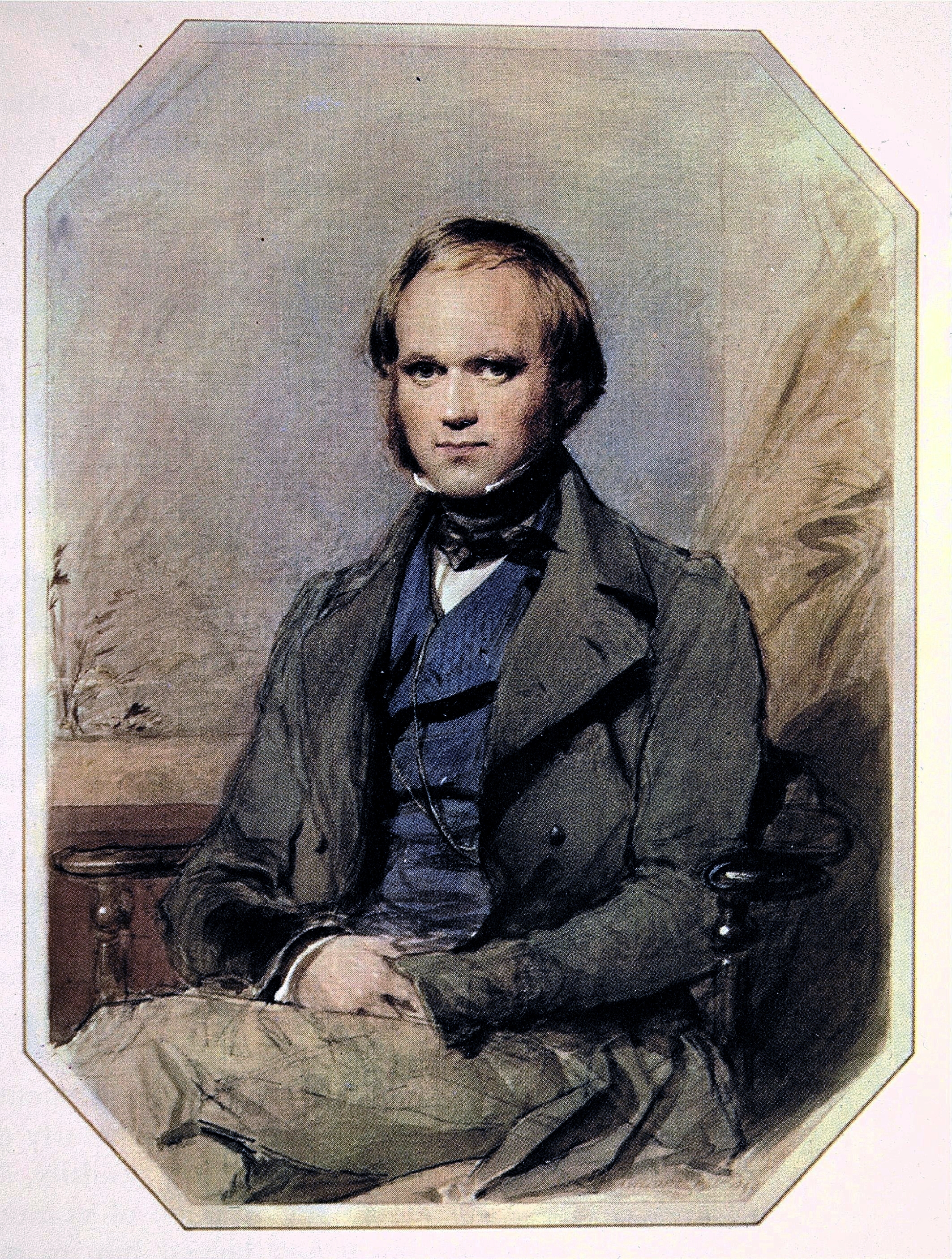
Image credits: Nick Risinger's conception of the Milky Way galaxy, from Wikimedia Commons, where you can also find an annotated version that shows where we live. The painting of Darwin (also from the Commons) is by George Richmond; Darwin sat for the portrait not long before he sailed on the Beagle.