Showing posts with label education. Show all posts

Monday, January 21, 2013

Cynicism and Utopia

 Note: This essay also appears on Owl's Farm

This is rather a momentous day, what with President Obama's second inauguration coinciding as it does with Martin Luther King Day.  It's also still the new year's honeymoon period, when folks haven't yet given up on resolutions made under the influence on New Year's Eve.  And, it's been a month since the world didn't end, and I turned 65. The days are getting longer, and I saw my first robin (although I'm not sure he ever went anywhere), but the weather's still in flux (50s today, up to 70s by Wednesday, back down to 50s at the weekend) so I don't imagine spring is exactly around the corner.  February is typically the coldest month around here, and although Christmas was the worst weather day we've  had this winter so far, things could always get worse.

I didn't really want my first post of 2013 to be a downer, and perhaps it won't be.  But what's on my mind these days tends to keep my spirits lower than I'd like.  I am by nature an optimistic person; I try not to be, because pessimists are frequently happily surprised when things don't go as badly as they expect. But when confronted by adversity, I tend to accept it as a challenge and try to make things better--or at lease accept what's not in my power to alter.

But I do worry about the future, because I'm faced every day of my working life with evidence that this country has no idea of how badly its educating its children.  Not a day goes by when the Daily Poop doesn't offer some "solution" to a variety of perceived problems in the schools:  inefficiency, lack of career and/or college preparation, inability to engage students in essential skills.  In Texas, our legislators are constantly trying to find ways not to fund educational efforts because they think that both schools and the gummint need to be run like bidnesses (sorry; government, businesses).  Teachers should be able to teach 35 kids as easily as 25; students don't need access to real books when they can be reading them online on antiquated computers.  Teacher salaries are a joke (and not a very funny one), and Texas doesn't want to raise them unless they can tie compensation to student performance.  And that leads us to the testing regime that assesses all the wrong things and puts so much pressure on students and teachers that nobody has the time or energy or desire to really learn anything. It's not any better for college teachers, either (at least in proprietary schools and community colleges), because we're under the assessment gun as well, since rising student debt is giving administrators the willies.  More and more pressure is applied to colleges to run students through in the minimum amount of time (whether it's four years, two years, or 12 quarters).  However, students come to us with less and less preparation, and they're finding it harder and harder to successfully navigate the demands of a college-level curriculum. 

Even if they do graduate successfully, what do they have to look forward to?  Wages are stagnating (raise? what raise?) while we're being asked to more for what we're already getting.  So productivity is up in the U.S., while paychecks don't change.  I was wondering the other day why it is that in 2007 I could sit down at my computer a couple of mornings a week and write a post for Owl's Farm--and being able to do that encouraged me to start the others.  These days, however, I have to have a four-day holiday in order not to feel guilty about working on this post for a couple of hours.  What I realized while I pondered the situation is that I am working longer every day to find ways to compensate for the fact that my students are so unfamiliar with the past that putting art into context is impossible without recounting the historical moment in which works were created. Talking about Jacques Louis David to people who know nothing about the French Revolution isn't quite like facing the guillotine, but it certainly does recall Goya's contention that "the sleep of reason produces monsters."  In order to set the stage, I have to consult high school teachers in Hawaii, who (being younger, more energetic, and more with it) have created music videos on historical topics to engage their students.  Lady Gaga's music as a background to the events of 1789 is a lot more fun than listening to me try to summarize them in an art history lecture.

So I read advice in the Chronicle of Higher Education, look online for what others are doing, search for engaging videos, and try to find ways to make information more accessible without dumbing down the course or lowering standards.  Finding ways to connect fashion, video, animation, and other programs to art history is now a full-time job, added to my other one--teaching, with all it encompasses (research, lectures, grading, learning new delivery technologies). 

Have I mentioned that I just turned 65?

I didn't really make any resolutions for the new year; but rather than grouse about the state of education in the state of Texas, I really need to have more fun looking for new material.  I've already located a couple  of promising avenues--connections between paleolithic painting and animation--and as long as I can keep myself entertained, perhaps I won't bore my students silly.  The Cranky Old Bitch persona, which can be amusing to some, wears thin after a bit, and I'll  have to don another Trickster costume if I'm to make it through to spring. I'm looking to new sources (The Encyclopedia of Informal Education) and old (Morris's essays on education), in hopes of becoming more hopeful.  What I really need to become is more cynical--though not in the contemporary understanding of the term.

As Daniel Halpin points out in his article for Infed, "Hope, Utopianism and Educational Renewal," "A cynic today is not the same person the Ancient Greeks meant by the term. For them the cynic was a critic of contemporary culture on the basis of reason and natural law - a revolutionary rationalist, a follower of Socrates." In fact, the word "cynic" comes from the Greek word for "dog,"  so Cranky Old Bitch isn't inappropriate.  We love dogs because they know whom to trust (us, we hope), and they're naturally suspicious. Cynics are naturally anarchists, so I've always been rather sympathetic anyway.

Now, I'm not about to go live in the marketplace in a barrel or piddle in the street, but I think we could learn something by revisiting the teachings of the cynics, and by recognizing, as Diogenes did, that there is a toxic aspect to civilization itself.  We've been trying to come to grips with this realization since before the hippies started dropping out in the '60s, and folks started camping out on Wall Street.  I'll write more about this in a future post, but for now, I think we could consider the influence of money on everything we do.  The utopian in me wants to try to find ways to find ways to educate on the cheap: do what I can with what little I have, and see where it leads.  Since I've got a shelf full of William Morris, I think I'll start there, and spend the rest of Inauguration Day/MLK Day snuggled up with my two mongrel cynics and some Morris essays, and try to figure out how to save the world.

How's that for optimism?

Image credit: Jean-Léon Gérôme, Diogenes, 1860. Walters Art Museum, Baltimore. Via Wikimedia Commons.

Saturday, November 20, 2010

Education and Citizenship

The arguments for smaller government that buoyed the ascendancy of tea-party conservatives in the midterm election can be very compelling. What is, after all, not to like about lower taxes? Why should the government be telling us how to live--by mandating warnings on cigarette packages, toying with restrictions on high fructose corn syrup, telling us what our kids need to eat at school, or insisting that everybody have health insurance whether they want it or not?

At the heart of the problem, however, is the fact that most of the public "argument" (such as it is) is based on faulty premises and a critical misunderstanding of history. Fueling the fight against the "socialistic" policies of the Obama administration is a badly painted picture of life at the birth of our republic, and the character of the (white, propertied) men who wrote the Constitution--and this dooms reason from the beginning.

No claim based on problematic reasons can ultimately succeed without rhetorical smoke-blowing and obscuring evidence to the contrary. Thus, many of the claims that opponents of "Obamacare" offer, for example, are supported by scary suggestions (not evidence) that health care reform will ultimately bankrupt our children, or that it will drive Granny to an early grave. Now, I'm more than willing to listen to your views, but only if you ground them in evidence; if the evidence is lacking, you can't just make stuff up. So if you're going to argue that "the Government" is violating the Constitution, be sure you've read it carefully, read commentary on what the articles mean (from more than one source), and pay some serious attention to the context in which it was written.

According to U. S. census figures for 1790, the first year a census was held, the population of the country in the year after the Constitution was ratified numbered around 4 million people. The figure for 2010 is upwards of 309 million. In 1790 there were no major roads, no electricity, no natural gas lines, no safe, reliable water supply--and thus no real upkeep or major infrastructure issues to fund. The U. S. Treasury fact sheet on the history of taxation notes that early taxes were raised from sources that varied widely from state to state:

Before the Revolutionary War, the colonial government had only a limited need for revenue, while each of the colonies had greater responsibilities and thus greater revenue needs, which they met with different types of taxes. For example, the southern colonies primarily taxed imports and exports, the middle colonies at times imposed a property tax and a 'head' or poll tax levied on each adult male, and the New England colonies raised revenue primarily through general real estate taxes, excises taxes, and taxes based on occupation.

One of the causes of that war, in fact, was the felt need of England to levy taxes on the colonies to pay for its wars abroad. The last straw was the tax levied on tea--and this seems to have also led to the future reluctance of American citizens to pay any taxes. The modern "Tea Party" seems to have forgotten that the battle cry of the tax protesters in 1773 was "Taxation without representation is tyranny." Like 'em or not, however, both houses of Congress are made up of elected representatives these days--so we're hardly being taxed without representation. If we don't like the results, we can throw the bums out. Which happens about every two years.

The point toward which I'm meandering is this: things are mighty different today than they were then. We no longer restrict the vote to propertied white males. There are gazillions more of us, a huge national transportation system that includes highways, railways, and airways, enormous electrical grids, gas pipelines, and all the other bits of technology that glue us together as a nation. And despite our overall wealth (even in these just-post-recession times), we do not have a measurably higher standard living than other developed countries that tax themselves silly.

Comparing the country now to the colonies in 1776 (or even the United States in 1790) is ridiculous. It's like comparing Adam Smith's idea of capitalism (kept in reign by the Invisible Hand) to the kind of capitalism that led to the recent depression. We're not even talking apples and oranges here; it's more like apples and lawn furniture.

The main purpose of government is to look after the public good by overseeing what can't be handled effectively by individuals or by individual states. And the first responsibility of governed citizens is to participate in their governance by electing representatives who have that good at heart. In order to do so, however, we have to be knowledgeable about processes and context; we can't just hop off and vote for any knucklehead who puts up a scary ad. The best defense against tyranny is an educated populace.

Now that the Supreme Court has declared that groups (corporations, unions, non-profits, and others) count the same as individual citizens, the job of educating ourselves becomes more difficult, because we have to be able to peel away all the subtexts that inform the ads that can be funded anonymously in favor of or against particular candidates. And because we've become not only less well-educated about but also less involved with national politics, we're much more susceptible to scare tactics and misinformation. On top of it all, we now get most of our news from commentators and pundits (whether Glen Beck or Kieth Olbermann) who specialize in verbal heat, rather than from reading newspapers and mulling over differing positions.

In the end, our value as citizens, and our ability to solve problems and insure the survival of the republic depends significantly on education. The more, the better, according to a 2005 report from the College Board. Participation in our own governance occurs in several ways, not the least important of which are through voting and paying taxes.

Now, I know the post-election mantra is all about reducing taxes. Some folks seem to think these are nothing but an imposition, and are used only to fund welfare queens and deadbeats. But in a country as large as ours, that depends so completely on the condition of its economic delivery systems (like transportation and other infrastructure), we cannot keep going without taxes. And the more prosperous we are, the more we seem to depend on these same systems--which means that our taxes need to be commensurate with our use of national facilities.

Remember that we all breathe the air, we all used the interstate highways, we share large public water sources, and so we do need oversight to keep individual states from deciding that they don't give a whiz about anybody else. (And if you think states don't do this, you don't live in Texas.) That means that in addition to paying taxes, we need to make sure the government regulates commerce to the extent that it affects individual citizens within the larger structure of the nation.

Education is about much more than just getting a job that pays well. A good education will provide us with worthwhile, interesting work that's more than just a paycheck. But it also helps us to fulfill our obligations as citizens by providing us with tools: critical thinking and mathematical skills (so we can evaluate arguments and understand statistics), historical perspective (so we remember what really happened in the founding years of our nation), and the general ability to articulate our positions and beliefs in order to make our voices heard.

It's extremely important to remember, in these almost radically anti-intellectual times, that our founding fathers were much better educated than most of us are today. Many of them read Greek and Latin, knew the classics, and were well-acquainted with the Enlightenment philosophies of their contemporaries: John Locke, David Hume, Immanuel Kant, George Berkeley, Adam Smith, Thomas Reid, Thomas Hobbes. Some of them, notably Benjamin Franklin, Alexander Hamilton, Thomas Jefferson, Thomas Paine, and James Madison, occupy the same pantheon as the Enlightenment thinkers from Europe.

I doubt seriously that many of those touting their love of the Constitution as a reason for opposing the duly elected President and Congress could hold a conversation with any of these guys--much less really understand what they were espousing. This isn't just an indictment of the noisy Right, but also of an uncritical Left. The architects of our government disagreed on many issues, but they were united in their belief that they could build a solid, enduring alternative to colonial rule.

I really hope we don't prove their faith to be ill founded.

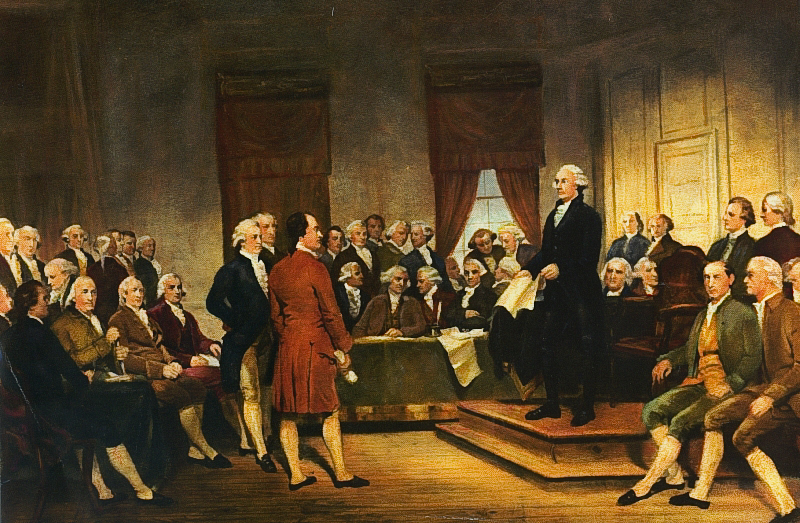
Image credit: Junius Brutus Stearns, Washington at Constitutional Convention of 1787, 1856. Via Wikimedia Commons.

Wednesday, April 7, 2010

Lords of the Flies

I know the title of this post repeats the observations of many people commenting on the current rash of bully-stories in various media. But it seems so utterly appropriate that I had to succumb.

The stories themselves are raw meat to the sensationalist television appetite currently in evidence. If a story isn't gross or gruesome or painful in some way, it's not worth reporting.

It shouldn't be surprising, then, that when a young Irish immigrant hangs herself after suffering severe bullying in a Massachusetts high school, the news shows and papers are full of it, and the pundits are after the story from all directions, left, right, and center.

What I don't understand is why anyone is surprised by any of this. We are allowing our children to raise one another, without much in the way of parental supervision or real guidance, and then we look for scapegoats (pardon me, causes) when they turn into monsters out of a George Orwell novel.

Don't get me wrong. I do not think the answer is helicopter parents who whirl around their kids and stuff their schedules with all manner of "activities" to keep them from becoming "bored" and then shower them with technological gizmos that remove the little darlings further and further from reality.

But children--even teen-aged children--should not be left unsupervised for long periods of time, encountering only their peers who don't know anything more than they do. In order to become responsible adults, children need to be educated, and they are quite simply not equipped to educate one another.

The roots of both "education" and "pedagogy" involve leading: leading out into the world, leading children. When we leave the process to the children themselves, we set up a situation in which the blind are leading the people who can't see very well. Some of these kids may have some experience of the world, but--in light of how we're raising them these days--that experience is highly restricted, mostly by technology.

I mentioned on the Farm the other day that one of my parents' most enduring gifts to me was the chance to live among Japanese and Chinese people, rather than Americans, when we were stationed in Japan and Taiwan. But another gift that I'm only now able to assess (because I thought I was terribly deprived at the time) was limited time with people my own age. Most of my life out of school was spent with adults: writers and reporters at the Foreign Correspondents Club and the Friends of China Club in Taipei, my father's fellow NCOs at his base, our "household staff" (a couple I regarded as my second parents, the "houseboy" and his wife, Lee and A-qui).

When I was with my friends, we were constrained by an invisible net of etiquette: the knowledge that our behavior reflected on the American community in Taipei, so that lapses in judgment or inappropriate displays in public were treated as major infractions and punished accordingly. We were trained to be little ambassadors, and most of us took this role seriously. There were the occasional goofballs who ended up embarrassing everyone, but I was fortunate not to encounter any of those--probably because they didn't attend the Catholic international school where Mother Superior reigned supreme and didn't put up with any crap from uppity children.

Eventually I came to value my close interaction with adults, and I think it provided me with terrific role models: successful writers and cartoonists, diplomats, nuns, priests, bishops, missionaries, translators, career military people, Taiwanese intellectuals, and a variety of European business folk.

Modern kids don't seem to have many opportunities like these; they not only don't have my weird and wonderful parents, but they also seem to be living in a different universe: one that values virtual reality over the real world, one that devalues intellectual pursuits, and one that worships youth and a comic-book concept of beauty.

I don't know what to do about bullies. We may already be too far down the line to do much but sit back and watch the coming apocalypse. But if we want to save the next generation, we almost certainly have to start spending our time with them, leading them away from the mob, containing some of their freedom with real education and companionship. How are they possibly going to learn to be responsible adults if their time with real role models is limited to a few hours with teachers every day, and a very few transient moments with parents?

If we bring children into the world, it really is our responsibility to lead them out into it--not to let them find their own way among their own kind, let loose to run around the island, deciding for themselves who should be "king" and who should be voted off.

Image credit: The Education of the Children of Clovis, by Sir Lawrence Alma-Tadema, 1861, via Wikimedia Commons.

Saturday, March 13, 2010

Educational Secession

I am becoming increasingly grateful that I no longer have to deal with school-age children, and do not envy in any way the choices friends with kids are having to make these days.

Although I was all set to extol the virtues of the Dallas Independent School District's current attitude about the value of school gardens as teaching tools (after having posted on the demise of one such garden a couple of years ago), all optimism was immediately dashed when the news hit the fan about what the Texas Board of Education is planning to do to social studies across the state.

If I had ever harbored any doubt about what I would do if I had to do it all over again, I have now been completely won over to the home school camp. Not only would my kids have a garden from which to learn real science, but they wouldn't have doctrine of any sort (religious or economic) shoved down their little throats. Fortunately for us, the Texas State Board of Education (SBOE) wasn't full of ideologues when my children entered public schools, and they were pretty much allowed to study a large variety of viewpoints and to make their own intellectual decisions about the worth of various arguments. I saw little evidence of any particular bias in any of what they had to read, and since I made sure that they had access to primary sources to consult in order to get at the real meat (rather than the text-book pabulum most schools teach from) of important events, they could always follow through on questions that arose from various topics.

Long gone, however, are the days when eleventh graders are asked to write papers like the one I picked out of a hat for my Junior American History and English thesis: "An Examination of the Concept of Property Rights as Contrasted in the Writings of John Locke and Thomas Paine." To write the paper, I had to read Locke and Paine and to explicate their positions. I can't even imagine that this could happen today, because the students who show up in my own classes rarely even understand how to support an argument, and most don't seem to have heard of either Locke or Paine.

In Texas these days, Thomas Jefferson (my own father's hero) is a bad guy (for having coined the notion of the separation of church and state), and Phyllis Schlafley and the Eagle Forum have been elevated to the pantheon of historical importance once occupied by Jefferson himself. I suppose that I should be thankful that Sarah Palin's tweets haven't made it onto the list of required reading (yet).

At the same time that this silliness is taking place here, the rest of the country (with the notable exceptions of Texas and Alaska) is busy scrambling to come up with a uniform set of standards students will be expected to reach by the time the leave public schools. No Child Left Behind has resulted in the lowering of standards in some cases, so the latest effort seeks to raise the bar and expect more, rather than less, of our graduates. Alaska and Texas are the only states that declined to participate in the standards-writing effort, and according to the New York Times article by Sam Dillon, "In keeping his state out, Gov. Rick Perry argued that only Texans should decide what children there learn."

What Perry and his revisionist crew don't seem to understand is that our students are neither naive nor fundamentally stupid. Many of them graduate from high school without being fluent in English grammar, basic mathematics, or even general history and geography, but they do seem to know when they've been hoodwinked. My students, once given the opportunity to learn for themselves, seem to rise to the occasion quite well, despite the handicap of a mediocre public education. In some cases, it's as if the blinders are being removed from their eyes when I encourage them to answer their own questions. I can only hope that the new social studies requirements don't completely numb the inquisitive and make it that much harder for them to learn once they've been set free from what passes for education in this state.

In the quest for academic excellence, at least, Texas seems already to have seceded from the Union. One can only imagine what future graduates of Texas schools will have to overcome should they choose to seek jobs and/or further education outside of the state. But maybe the SBOE just wants all its graduates to stay in Texas. The Lone Star State will, of course remain totally unaffected by climate change, peak oil, or any of the other problems concocted, according to our esteemed politicians, by left-wing alarmists bent on destroying our free enterprise system. We can't even call it capitalism any more, because that's also been sullied by the left.

It's just as well, I guess, because the next generation of Texas graduates would have been taught that none of this will happen--or that if it does, it's all part of God's plan.

And if we're bent on purging figures the SBOE doesn't like from the ranks of historical importance, it probably wouldn't take too much work to alter the figure of Jefferson on Mt. Rushmore to make it look like Phyllis Schlaffey--if the gang of five on the Texas Board of Education could persuade South Dakota to go along.

Photo Credit: Mt. Rushmore, Thomas Jefferson Up Close, by Scott Catron, via Wikimedia Commons.

Saturday, January 9, 2010

The Case Against Textbooks

As more and more colleges agonize over the rising cost of textbooks, I would like to don my Swiftian hat here and make a modest proposal.

And, no, it has nothing to do with creating baby-skin lampshades.

Rather, I would suggest that institutions of higher learning get smart, talk back, and tell the textbook companies where to shove it.

I can say this because I never once used a "textbook," either as an undergraduate or a graduate student, at any of four major universities I attended: the University of California at Riverside, the University of Pennsylvania, the State University of New York at Stony Brook, and the University of Texas at Dallas. This represents a fairly wide geographical range, and both private (Ivy League) and public institutions. I also have to admit that I'm excluding Greek and Latin grammars from the category of textbook. In the interest of full disclosure, I must also confess that I suggest to my History of Art and Design students that they buy a comprehensive art history survey, much as I suggest that they also have a copy of a good dictionary; I refer to both, but teach from neither.

In fact, I probably need to clarify what I mean by "textbooks" (as opposed to "texts," which, as all good postmodernists know, include anything that can be interpreted): books intended to teach a subject in broad introductory terms, in schools or colleges. They typically do not contain much in the way of original research or interpretation, but rather categorize and summarize information. They may offer a broad perspective on a topic, provide condensed historical or practical information, and are supposed to represent a kind of state-of-the-subject picture, especially in fields commonly taught in liberal arts institutions: history, the sciences, maths, and the humanities. I contrast these with the monographs that made up my education: books by the likes of Homer, Joyce, Swift, Goethe, Morris, and even the four evangelists and the writers of the Pentateuch.

Textbooks also tend to be written by committee (not necessarily a bad thing), profusely illustrated (also not necessarily a bad thing), and usually very expensive (in part because the aforesaid profuse illustrations and committees cost a great deal of money). They're also ubiquitous, and some colleges seem to be having fits about the cost of these books to students, and whether they should require them as actual or digital books. The proliferation of e-books and digital downloads makes it increasingly more likely that textbooks will become a permanent fixture in virtual reality, thus reducing the number of trees killed for spurious reasons--but the textbooks themselves will remain.

In addition, these books (especially the computer programming textbooks I used to illustrate the post) tend to contain material that becomes dated the minute new scholarship or new technologies emerge, so that they constantly need to be updated, new editions produced, and their prices increased, thus further exacerbating the problem. Since most software programs come with tutorials, why do instructors even need to assign textbooks in the first place?

So here's my solution. Nix 'em. Teach what you know, and write and develop your own materials. If you don't know the stuff, you shouldn't be in the classroom.

I saw one argument once that beginning teachers don't have enough experience to write their own curricula, and therefore absolutely must use a textbook written by an expert. If this is the case, what is it that they were learning in college or teacher-training programs?

I was told in a faculty development meeting just this week that I'm an expert. I sure as hell should be, after 190 graduate hours acquired during 15 years of full- and part-time schooling, not counting eight years of undergraduate education at top-notch schools. But what the facilitator meant is that we who teach are assumed to be experts in our fields. We've all got, at the very least, Master's degrees, and most of us have real-world experience related to what we teach. We all presumably spend many hours each year keeping up with current developments and advances in our subject areas, attend conferences, write peer-reviewed papers (or, in my case, blogs open to the scrutiny of any peers who happen by), participate in workshops, read monographs, subscribe to journals, and employ myriad other means to help us keep abreast and learn new stuff.

In addition to all these traditional resources, there's now the Worldwide Web, with online material that expands daily, the quality of which seems to improving all the time. Thanks to my laptop, the internet, and my college's library, I can now access millions of peer-reviewed articles, read major world newspapers, subscribe to the Chronicle of Higher Education, and commune with scholars and creative people all over the world. I can participate in virtual digs (I started out life as an archaeologist), read field reports, enjoy scholarly blogs, and take advantage of the TED lecture series. One of the most promising aspects of all this is the technology that allows me to read books online that I would never be able to even see in person except under glass or with hard-to-acquire special permissions: the Kelmscott Chaucer, Darwin's notebooks, Leonardo's sketchbooks. The means for perpetual learning are now quite literally at our fingertips.

So why are so many people so bent out of shape about spending preposterous amounts of money on textbooks good teachers don't really need? If we are indeed well-prepared enough to be "experts," why can't we be trusted to gather the material we need to teach our students what they need to know or, better yet, to provide them with the tools that make it possible for them to participate energetically in their own learning?

I suspect that there are several answers to these questions. Some beginning college instructors don't feel confident enough to strike out on their own, preparing their own lessons and assigning their own choices of primary texts and secondary works that could generate questions they might not be able to answer. If we're assumed to be experts, after all, we can't not know the answers. Although I'm not sure why the notion of "expert" implies "omniscient," this does seem to be a prevailing sentiment. And it creates a problematic model in the mind of the student: there is an answer; once we know it, we don't have go any further.

Another reason, I hesitate to mention for fear that I might sound accusatory, is intellectual laziness, which seems to be endemic in some schools these days. It's too much trouble to do all that work analyzing and collecting suitable readings. Why not order a textbook, where somebody's already done all that work for you? It's much more time consuming to select works and readings by great writers and thinkers, to locate ancillary materials, to search for appropriate websites in the growing pantheon of content-loaded interactive pages.

Oddly enough, though, it's considerably cheaper. A few paperback copies of significant works and PowerPoint slides built from images freely available on the web or through one's college library might well provide the basis for a top-notch humanities class. Surely the original works, some commentary, and some explication on the teacher's part, and a lot of healthy discussion and research would be far more interesting than slogging through chapter upon chapter of textbook condensations or pre-selected readings.

Still another explanation is the problem of suspicion or ignorance on the part of authorities--those in charge of running the show. An administration may have hired us, but because few of those who hire know what we know, they may not trust us enough to afford the kind of academic freedom that allowed us to become the well-trained, academically qualified, committed teachers that we are in the first place.

I fully realize that the academic world in which we now live is not the one in which I was educated. My teachers all knew well of what they spoke; they lectured, we took notes, asked questions, conducted research, wrote papers, discussed those papers, responded to critical assessments, and graduated from college and graduate school having learned the way people have learned ever since the idea of the university began in the Middle Ages.

That model is increasingly under attack in a world that demands interactivity, instant gratification, and entertainment--as well as "accountability" (which I suspect is engendered by our also increasingly litigious society). I quail to think of what high school is like these days after having read a feature essay in today's Daily Poop by a high-school Junior who likes the idea that libraries are now noisy, because it means that people have finally learned how to mix education with entertainment. I'm not sure how forty years of Sesame Street fits into her world. Maybe she missed it.

Ye gods and little fishes! What brave new world is this that has such people in it?!

For the moment, I'm out of steam. But I'll return for another chapter soon, perhaps with some suggestions for how to do what I say we should be doing.

Image credits: A row of computer textbooks uploaded by K.Lee; A detail from Jan van Eyck's The Madonna and the Canon Georg van der Paele, 1436; and Carl Spitzweg's wonderful The Bookworm, 1850 (I have a print in my study). All from Wikimedia Commons.

Saturday, June 27, 2009

Shop Talk

In previous posts on the Farm, I've outlined my fondness for William Morris's philosophy of work and the dichotomy he saw between useful work and useless toil. I'm also an advocate of experiential education, the education of the whole person (as opposed to the education of the intellect alone), and (again inspired by Morris), the education of desire--which lies at the very core of my views on the environment and sustainability.

Last week on the Colbert Report, one of the guests was Matthew Crawford, a contributing editor for The New Atlantis and author of a rather intriguing book, Shop Class as Soulcraft: An Inquiry into the Value of Work. I'm already thinking, without having actually read the book (it was preceded by an essay of the same name in The New Atlantis, which I have read), that Morris would love it. And its premise, that doing things is every bit as important intellectually as talking about them, is enough to make me a fan for life. After all, my own little-read tome, More News From Nowhere, describes a society built on both doing and thinking, and fosters a kind of organic education that involves both the concrete and the abstract.

Some of my students may recall our conversations about the Bauhaus, and my arguments against the separation of art and craft. The Bauhaus, after all, combined a Foundation Course in theory (including material on the study of nature and the study of materials) followed by workshops under the tutelage of craftsmen and artists that put theory into practice.

I was personally affected by the American predilection for "tracking" students in elementary and secondary schools when I returned to the States in time for high school. "Smart" kids were put onto a college prep track, and "the others" were channeled into vocational studies. What that meant for me was no home ec, no art classes, no shop classes. Only academic studies. The one time I managed to break out of the mold was when I was a Junior and talked somebody into letting me take a typing class because I argued that it would help me write papers in college.

As it was set up, tracking was overall a bad model and led to a system of inequality that still exists. What seems to have sprung up in its stead (probably in an effort to address issues of "classism" in the seventies) is another bastardization of educational management: the idea that everybody can and should go to college. Now, I'm all for equal opportunity, but what if somebody really wants to spend the rest of his or her life building cars or airplanes or houses? Of course, one can argue that educated citizens make better construction workers--but why do they have to go to college to "get educated"? Especially if these folks are going to sit and stare at their philosophy teacher with the standard "why the hell do I have to take this class" look on their faces.

Matthew Crawford points to the origins of the problem in his interview on the Colbert show, where he spoke of the "pernicious and long history of tracking into vocational and college prep" courses, based on the "dichotomy between mental vs. manual" education--which in turn is based on a perception that "knowledge work" is better than manual work. Somehow, along the line, vocational training got a bad rap, and "knowledge work" took on an elitist mantle.

The idea that four-year colleges are necessary for future success in any field is just bogus. Community colleges or technical schools that provide continuing education in basic subjects like writing, maths, and general science can foster cultural literacy, leaving more of the time students would need for practical education on how to fight fires, build homes, or arrest felons.

I'm actually a product of the basic prejudice, as the first member of my working-class family to finish college, and I've resented the fact that, as a "smart" kid, I was channeled along paths I might not have taken. Many of my generation (cousins and siblings) followed me along the college route, but ended up in rather more practical professions: nursing and civil engineering. I don't regret the emphasis on intellectual pursuits, nor even the "impracticality" of studying Classics, archaeology, and philosophy. But the emphasis on preparing myself for a purely intellectual career sidetracked me from art and design, and it was only jobs that involved developing design skills that provided the needed education. Tracking backfired and probably started me down the path toward my present anarchic stance on education.

Now, of course, I live in the best of both worlds--for me. I get to teach history and philosophy to design students, and am constantly learning to combine the intellectual with the practical. But the lingering effects of valorizing the former over the latter can be seen in recent debates among my colleagues about how we should teach our students. Some have been educated in environments that lack the structure vocational training maintains, and would prefer to inspire their students to creativity without the strictures of formal lesson plans--and the debate will continue as long as the dichotomy survives.

On the other hand, I've been inspired to focus more carefully on Morris and the Bauhaus in my history classes, in order to emphasize a different history: one in which "knowledge" isn't confined to an intellectual model, but pervades learning in both the physical and mental realms.

Since I frequently have to address the question, "what does this have to do with becoming a graphic designer?" (or a fashion designer or a filmmaker or a web guy), my response usually has something to do with "knowing what's in the box" (and I'm getting rather weary of my own version of the box cliche) I'm actually pretty good at convincing design students that knowing about art history is a valuable adjunct to creativity (if for no other reason than showing them what's been done before). But I'm not sure how we're going to keep educating people in the classics anyway, now that popular culture is hell-bent on denigrating intelligence and shortening attention spans.

As literature and the performing arts continue to lean toward the lowest common denominator, the endurance of any kind of canon is in question. We may need to turn to something like John Ruskin's Working Men's College (which still exists in London) to provide continuing education beyond the fulfillment of vocational requirements--were we to begin paying attention to the training needs of the people who do some of the most important work around. After all, where would most of the folks in Dallas be had there not been electricians to repair downed lines after the last whopping thunderstorm? I strongly suspect that the intellectual vacuum created by reality TV and inane movies will eventually drive at least some of our future plumbers and such to seek intellectual stimulation, on their own terms, just as the workers of nineteenth-century London eagerly took advantage of Ruskin's drawing classes.

I think this issue is well worth pursuing in later posts, so this is by no means my final take. For related earlier comments on Owl's Farm, see the links to the right, and stay tuned for further ruminations.

Image credits: "Workshop" by Felipe Micaroni Lalli; Bauhaus image by Jim Hood; John Ruskin, self portrait, watercolour touched with bodycolour over pencil, all from Wikimedia Commons.

Wednesday, February 11, 2009

Teaching Teaching vs. Doing Teaching

A debate of sorts (mostly one-sided, with me on the one side) has recently arisen on campus about the distinction between "professional development" and "faculty development," because our particular corporate culture thinks that college teachers constantly have to be taught how to teach, no matter how long they've been at it.

A few years ago, I wrote a rather infamous letter to our then-HR person when the faculty development (they weren't making much of a distinction then) requirement went up from twelve hours per academic year to eighteen--because we had been so good at meeting the twelve-hour requirement. I can still remember the opening line of the letter: "I don't know how you spent your summer vacation, but here's what I did"--and proceeded to recount everything I'd done on my two-week break between the spring and summer quarters. These included museum visits on the drive between Dallas and eastern California, visits to national parks, archaeological site-visits to photograph stuff I talked about in class, all in the ten days it took to drive there and back again. I even got in a couple of days' visit with my folks.

I returned to a notice during our "in-service" period (it's called Twelfth Week, but I don't think any connection with Shakespeare was intended), that we needed to jack up the hours we spent learning how to teach (or what to teach). Never mind that we almost never don't teach. This is a proprietary four-year college, in session forty four weeks per year, and full-time faculty are on campus thirty hours per week, teaching a required load of five four-hour classes (or combinations of course loads that add up to at least twenty hours). Comparable community college instructors teach five three-hour classes per semester (fifteen weeks), for two semesters, with extra pay for teaching summer classes. And although they are expected to show evidence of professional development and academic citizenship during their annual performance reviews, there is no "clock-hour" requirement and no distinction between "how" and "what" they teach when it comes to doing so (they can publish, go to meetings, participate in symposia, etc.). The semi-annual all-college gathering usually features a speaker who talks about new educational trends, but there are no required "PowerPoint and the Future of Education" lessons.

Okay, so we're different. Our faculty members are, for the most part, artists and design professionals who have not necessarily been mentored into teaching like most college teachers. New instructors (no tenure system here, so we're all "instructors") are required to attend faculty orientation sessions which include training in how to teach, the concept of a learning-centered environment (as opposed to a teaching-centered environment), and if, during their first few quarters they run into problems, they're provided with tools and training to help them get over the hump. The requirements are the same for both program and general studies instructors, even though gen ed graduates have almost always spent time teaching under the supervision of their professors.

Lately, however, the Powers That Be have decided to increase the faculty development quotient; we're now responsible for twenty four "clock hours" of training on how to teach what we teach. This is in addition to a less well-defined component of professional development, which encompasses fields of expertise. Because we are accredited by the Southern Association of Colleges and Schools (SACS), our instructors are now required to earn master's level advanced degrees (with corporate pressure to make these terminal degrees, such as MFAs and PhDs). This very fact makes professional development a no-brainer for people in grad school.

But here's my problem: why do we have to distinguish how we teach from what we teach in the first place? Socrates would most certainly be rolling around in his grave, since teaching and doing philosophy were, to him and to most of us who have adopted him as a model, the same thing. You are, as I keep harping, what you do. This is how philosophers see the world; one can't even really do philosophy without teaching it, because that's what writing and interpretation is all about. Some colleges, like Kent State, seem to make little distinction between the two, and I'm sure they're not alone.

I'm not saying that how-to-teach seminars can't be useful. A couple of years after my post-summer break tantrum, we had a workshop on how to create rubrics that describe what each grade we post actually means. What constitutes an A or B? What distinguishes a B from a C? This turned out to be such a successful strategy (because it solves the "numbers" problem for those of us who find it difficult to quantify learning) that I immediately went through my courses and objectives and made beautiful charts to help me determine how well my students were achieving the objectives. These are now tied to evaluation sheets that accompany every graded project my students submit.

I also balked at the idea of lesson plans (that's so high school, I smugly complained), but after laying out week by week and topic by topic what I wanted to cover over the quarter, and how I wanted to assess my students' accomplishment of goals, I was hooked. These plans have changed over the years as I modify content and approach (after using my reflective assessment process to figure out what's working and what's not), but they're also coming in really handy as I prepare to take a quarter off to get my heart working properly again--so I can go on teaching for as long as anybody can stand me. Sessions on how to construct good lesson plans would, therefore, be useful, especially for general studies types like me who are more used to seminars where everyone reads the same stuff and then discusses, interprets, and writes about it.

Art and design history courses, like those I mostly teach, require careful planning to make sure students are exposed over and over again to images, their context, and their history. They require critical analysis as well, which is difficult to accomplish in a school (and a world) where students just don't read. I can assign readings until I turn purple, but unless I test them on the content, they won't even click on the link that takes them directly to the pages I want them to consider, much less read and take notes on the content. I don't give true/false, multiple-choice, scanable exams, so students have to spend most of their time creating workbooks that contain images and notes based on the lectures. Nobody else I know of does this, and so over the years I've flown by the seat of my pants. I have to learn by doing, as I have this quarter, that just assigning the stuff isn't working. I'm going to have to develop activities for the workbooks that take them beyond the lectures (where they're often quite engaged and even curious), and more deeply into representative artists, works, and movements. I have to work even harder at finding ways to encourage them to actually think about what they're seeing.

In order to do this, I read books, scour the internet, read the Chronicle of Higher Education, and pore over popularized treatments of art history like Ross King's books (Michelangelo and the Pope's Ceiling, Brunelleschi's Dome, The Judgment of Paris, etc.) and Margaret Wertheim's wonderful explorations of the junctures of art, science, and technology (The Pearly Gates of Cyberspace). In fact, I read about thirty books a year on science, culture, art, and history--and I'm not sure why that doesn't count, even though these books--in teaching me about stuff I don't know and making me think--are teaching me how to teach. I also blog my brains out, which requires me to explore topics I might never have even thought of considering, as I respond to what others are teaching me.

The upshot is this: I cannot separate how I teach from what I teach. They are forged continuously together like the shards of Narsil into a complete sword, or knitting into a sweater, or layers in Photoshop into a finished image. Of course, nothing is ever finished, because everything flows--as the early philosopher Heraclitus famously noted. You may never be able to step into the same river twice, but if you attend to what you're doing, you'll notice how the stream changes, and detect patterns that might help keep you from falling in and drowning.

Enough with the bad metaphors. But my plea is that education, even in a corporate setting, be more accommodating to innovation and accident--and to process. Three hours spent sitting through a "stress management" session amounts to three hours I can't be reading a good book that will help me become a better teacher because it engages my little gray cells and causes me to make useful connections. If you want to manage my stress, get me a massage (we did that once; it was wonderful!).

Or, offer more of what a colleague and I did before this quarter began. One of our chef instructors and I discovered that we have a common interest in the history of food and how cultures develop their distinctive cuisines. So we put together a presentation on Egyptian food and culture (called, rather absurdly, "A Taste of Tut") that showed how the humanities and the culinary arts interact. In order to get it accepted as a suitable topic for faculty development training, we had to stress the interdisciplinarity of the project, and the co-operative aspect of the "teaching." But we had a great time, attendees learned some things they didn't already know, and the chefs made some great beer.

Now that's faculty development. But it's also professional development. So maybe we should re-think the distinction and become more generally interdisciplinary in our approach to how we teach what we do. I can almost guarantee that the faculty will be more content, less cantankerous, and more engaged--which, I suspect, would be good for us all.

Image apologies: Hendrick ter Brugghen's Heraclitus, at the Rijksmuseum Amsterdam. The Naples Socrates, by Domenico Anderson, in the Museo Nazionale di Napoli. Both via Wikimedia Commons. Heraclitus's tattoo is courtesy P22 Fonts (Acropolis Now) and one of Patrick Lynch's heart diagrams (see the Cabinet for more). I stole the idea for Socrates's mustache, of course, from Marcel Duchamp.

Friday, January 2, 2009

Reflective Assessment

A great deal of criticism is being leveled at the current vogue of high-stakes testing in elementary and secondary schools. And rightly so. I've actually blathered on about this issue on the Farm, but I've also been trying to figure out how to measure student learning without falling into the quagmire in which public primary and secondary schools find themselves. The push for numbers that reflect how students learn has produced an education system (if we can call it a "system" at all) that favors quantity over quality, and that makes good on its promise that no child left behind only by leaving them all behind together. Teachers, quaking in their boots over the possibility of being fired if their students perform poorly on poorly designed exams, teach only what the test requires, and the little automatons march out of school in tidy rows, knowing a few facts but having no idea of how to think.

And then they march on into college having also been sold on touchy-feely visions of their own worth as persons, given prizes for being there, and patted on the back and awarded a medal when they "try." To do otherwise smacks of elitism, and violates some bizarre notion of egalitarianism that equates existence with excellence.

And then we get 'em. What's a college teacher to do, when faced with a classroom full of shining faces that expect to be given grades, and rewarded with advancement simply for showing up?

A competitive classroom also can provide a rude awakening to the pampered, who tend to be ill prepared to fight their own battles or account for how they arrived at a particular solution. "I like the feel of it," they say, unable to explain why. Or even what "feel" means in this context.

So we deal with the situation however we can. We start them over, in essence, in order to give them some idea of how things will be when the enter the "real world" of the marketplace, using every tool at our disposal to help them learn how to take constructive criticism, analyze and solve design problems, or even help them overcome twelve years worth of not learning how to learn.

Every five years or so, along come the accreditation folks, to assess how we assess our students. Show me the numbers that indicate that you're constantly improving. Show me the tests, the charts, the rubrics, the data. But those of us who don't collect "data," who follow a more evolutionary process in our teaching, are left with a conundrum. Do we fall into the trap, contriving tests to "measure" what our students learn? Or do we continue to follow our teacherly instincts and use our training to understand what's going on in our classrooms, and try to address issues as they arise, term by term?

In wrestling with the fact that accreditation is here to stay, and that it does serve a purpose (it keeps some of the really shoddy operations at bay, and maintains basic standards that offer students assurance of at least a measure of quality), I've spent a long time thinking about how to assess the progress students actually make in my classes, but in an authentic, meaningful way. I can't really do it with numbers, other than by keeping track of grades, so there has to be a way to account for what goes on that doesn't rely solely on instruments like Scantronable tests.

As I looked back on how I grade and how I prepare for classes each quarter, I noticed a pattern. At about week 7 (of 11) I invariably start making notes about what's working and what isn't. One measure is to look at how students perform on particular exam questions at midterm. If a large proportion don't "get it" I examine my presentation of the material, the wording of the question, and even the classroom environment: the dynamics of a particular group, the performance of the technology I'm using, whether or not students are using computers to take notes, etc. Sometimes I can quickly determine the source of the problem and address it. I always go over the questions after the exam to obtain the students' perspectives, and then make note of the need for change the following quarter, or even on the final exam.

This had never been a particularly organized or formal process--just something I've done as a matter of course. And then I realized that the narrative I write every year for my performance review, about the year's successes and failures, reflected what I had learned from this informal process.

With these two basic elements in mind, I set out to create a template for a more structured process, and I came up with the following elements. I call it "Reflective Assessment" because it's based on the process of thinking back, and then thinking forward. It's probably something we all do, and it's a perfectly natural and certainly more "authentic" way to ascertain how well our students are learning than simply charting numbers based on tests that can't really measure thinking in the first place. As thought-provoking as I try to make my exam questions, they're never going measure much more than how well students have taken notes and paid attention.

The first step is to maintain a notebook in which to jot down issues that arise during the quarter. Sometimes these notes show up on sticky-pads and such, but these can be pasted into the notebook, along with miscellaneous scraps of paper we happen to have on hand while watching a film or during a lecture. The idea is to divide the notebook according to the courses we teach--one section for every preparation--as a way of centralizing what comes out of the everyday activity of lecturing, demonstrating, discussing, and whatever else we do as teachers.

The notebook then becomes the basis for a more formal reflection and assessment at the end of the quarter. I tend to do this anyway, as I update each syllabus, schedule, and (because I have internet pages for each course I teach) website, but the notebook now makes it much simpler to remember what needed changing, and often contains suggestions for how to make the changes.

In order to tie the assessment into the objectives of the course, a copy of the course rubric is should be included, along with the stated outcome objectives and exit competencies.

Before my annual performance evaluation, I now use the notebook, where I also record the changes I've made, to describe what has occurred in each of my courses over the year. In future, I can see the notebook's becoming a tool for developing new courses as well, and I'm planning to add a "curriculum development" section--at least until those ideas overflow the space allowed them and need a notebook of their own. I'm starting to write a quarterly assessment for each class, based on the notebook, with plans to consult it before I create my midterm exams, in order to make sure I'm attending to previous issues.

The main problem I've encountered with this system so far is that the notebook isn't always handy, which is why I like to have sticky-notepads among the materials I take to class, on my desk at school, and at home. I have one nearby when I'm grading exams and essays, too. The pads are getting bigger (the little square ones aren't all that useful), but it's rather entertaining to have a bunch of colorful bits stuck higgledy piggledy in the notebook--where they can be re-arranged as necessary. Different colored pads for different classes might be a good idea, too, but I'm not that organized yet. Mostly I use the free ones I get from publishers.

Since the process is fundamentally dialectical, the final step should involve discussing the results of each course assessment with the program or department Director, perhaps in conjunction with the year-end review. His or her comments could be added to one's teaching portfolio (I keep my narratives in mine), and the results of these conversations would provide an overview of the instructor's ongoing assessment process over the years.

The only drawback I can see to formalizing the process is that SACS evaluators might look askance at having to read through the notebooks, or even the performance narratives. But if they're really interested in transforming the quality of education by finding meaningful ways of improving instruction, reflective assessment will almost certainly give them a better picture of what's going on than a few pie charts would.

And then, of course, we could still illustrate each year's assessments with beautifully-designed charts and graphs that mark the rise and fall of grades and the vicissitudes of teaching in a world that doesn't really seem to want to learn. But that's another problem, for another day.

Image credit: Wall painting portraying a scholar, from Herculaneum, first century CE. Wikimedia Commons.

Thursday, October 2, 2008

The End of Metaphor?

Before tonight's debate, which I probably won't watch (it's really hard on my blood pressure; instead, I read transcripts the next day. I do, however, occasionally watch with the sound off to see what body language looks like), I decided to get something off my chest. So far I've hesitated to blog roughshod into politics because some of my best and most beloved friends and family espouse views that differ significantly from mine. In truth, despite my often apparent "leftiness," I'm a fairly conservative person--in terms of family values, hearth, home, all that stuff. And despite my fairly radical anti-capitalism (at least capitalism as it has emerged since the Industrial Revolution), I have a lot of views that folks might think of as pretty conservative.

One of these concerns the idea of democracy. I think, in essence, that Socrates and Plato were right. Democracy doesn't work unless the populace that practices it is educated; otherwise you get mob rule. A person can't get a whole lot more conservative than siding with an ancient Greek dead white guy.

Today, of course, participation in governance is the birthright of every citizen in this country and in other modern democracies and social democracies. Citizenship entails responsibilities as well as rights--which is as it should be--although many seem to forget the responsibility part in the heat of political campaigns.

At any rate, at the risk of offending all sorts of people, I'm going to go out on a limb here and tell you why I think John McCain and (even more so) Sarah Palin are not good prospects for leaders in a modern democracy--especially one trying to maintain a place of power and prominence in an increasingly global economy.

It has to do with metaphor. Human beings, whom I like to refer to (as a species) as homo translator (man the translator, or metaphor-maker), rely on metaphorical thinking. As I've noted previously, there are two basic ways human beings learn stuff: by hearsay and by experience (Socrates develops these two varieties of education in The Republic). We learn when people tell us stories about what they and our ancestors have done, and we learn by doing things ourselves (remember chemistry lab?). Both of these ways of learning provide us with examples from which we can extrapolate ideas and apply them to new situations. Both similarities to and differences from other situations (ones we're more familiar with) help us to understand what's going on.

The value of formal education is that it expands our repertoir of examples by encouraging us to learn many more stories than we get locally (from family and friends, and in our own time). These stories add to our "cultural pool of metaphor" (the term comes from Gerald Holton) by including information from a much vaster range of people and from a much broader temporal spectrum than we could ever actually experience. We couple those stories with our own "local" learning and experience to gain a more broadly-based, richer education. I won't go as far as Plato and Socrates in saying that popular knowledge doesn't really count; but I will say that book-learning and wider exposure to the world prepare leaders better than does hanging around at the local saloon, drinking a Bud Light. Not that pub-crawling isn't good for philosophy; without the taverns in Edinburgh, the Scottish Enlightenment might never have happened, and Adam Smith might never have written The Wealth of Nations.

As I was saying, these combined modes of learning form the foundation for the kind of education needed to run a democracy. If some people have vastly diminished learning resources, they can't participate as completely or as well. And this is one of the abiding difficulties facing modern democracy: making sure every citizen has the opportunity to become well educated and to participate in governing his or her country.

The word "populist" has recently exploded into our common vocabulary to describe a particular kind of political candidate. It's gone beyond an earlier description of someone who rises from the working or middle classes and represents the concerns of most citizens. Very recently it has come to refer to someone who's not only not a political insider, but also not an "elitist." Populists of this description don't necessarily have much of an education, but can draw on even fairly restricted experience because they "know what it's like" to be an average Joe, to be like "everyman" (or "everywoman"). They don't have to know about tough subjects like economics, because they'll have people to advise them.

So a few questions begin to emerge: if you don't know much about a subject like economics, how are you going to evaluate the advice you're given? If you have no grounding in international relations and understand little about other cultures, how are you going to know if somebody's selling you a bill of goods when his or her advice is to wage war? If you're not conversant with the fundamentals of capitalism, how are you going to negotiate the nuances of the horrifically complex system that has emerged in the last century, and is now compounded by the reality of globalization? If you don't understand basic environmental science, how can you govern in a time of climatic crisis?

As I listen to Sarah Palin stumble around questions in interviews, it becomes clear that she is just not very well educated. She does seem to have plenty of street smarts, and good local political instincts (because she is just like the people she governs in Alaska). Her pool of metaphor is adequate for people who have a passel of kids, drive snow mobiles, work on pipelines, play hockey, and shoot moose (or wolves). But most of the world shares only one or two of these experiences; it's clear, for example, that aside from child-rearing she shares little enough with me. Palin's metaphors are primarily local and extremely hackneyed. She lacks the historical and cultural background that true world leaders need simply to hold a conversation with one another for longer than a brief introduction at the UN. Her entire candidacy is based on strongly held, inflexible religious and political views, and severely limited experience of the world.

John McCain, on the other hand, has both education and experience on his side. Being a graduate of Annapolis ensures a young Naval officer of a solid academic background, albeit one focused on what makes a good military man (and although he graduated near the bottom of his class). A significant chunk of his experience, however, comes from his incarceration in Vietnam, and very few of the rest of us share anything like it. We have no way of knowing how it colored his understanding of the world. His time in prison also looms so large in his life that it seems to have become the central defining metaphor for every other experience. And when I listen to him debate and participate in interviews, seldom do I not hear a reference, either open or oblique, to what he endured and what it taught him. As horrific and impossible for the rest of us to truly understand as it was, it happened half a lifetime ago. His experiences since that time, however, take a back seat to that single, all-consuming narrative.

Because of his less-then-stellar academic record, McCain's educational credentials don't make him susceptible to complaints about elitism. He doesn't have to apologize for an Ivy League education or for a reputation as a thinker. In that, he and Palin share a populist pulpit from which they can make fun of deliberation and intellectualism, and brag about making decisions with their guts or without blinking. And this is precisely where I have a problem.

The careful thinking-through of problems that comes with broad experience is a quality I would like to see in someone who works next to a red telephone and has a button within reach. I do not want somebody who reacts with his or her guts rather than his or her brains. And I want as leaders people who have enough cultural experience to include books like John Hersey's Hiroshima, Herman Wouk's The Winds of War, and films like Seven Days In May and Dr. Strangelove in their library of metaphors.

When we begin to denigrate our public intellectuals and to decry intellectualism as elitism, we are also sending a message that does every child in this country a disservice. When we make fun of smart people, but make our kids suffer the indignities of today's public schools--and then tell them that they have to go to college--we're sending them a very mixed message.

Unless we start electing people with the intellectual substance to solve our economic problems and rebuild our reputation among other world leaders and their constituencies, and until we have a president who's smart enough to evaluate evidence carefully and honestly, we'll continue on the path laid down over the last eight years. And without fresh, complex, vibrant metaphors and examples on which to model an alternative future, there's little hope that things will get better any time soon.

On a conciliatory note, if anyone's still with me after this rant, I'll end with a apt quotation from Editorial Anonymous (a blog on publishing children's books), which sums up my view of party politics:

. . . I don't mind what party people align themselves with. The nice thing about book people is that they're thinking people, and as long as you're thinking, you get to vote however you want. The people who drive me crazy are the ones who vote "from their gut". . . . Thinking people like to talk civilly and intelligently about issues, and as long as you're ready to do that, you're in the club.

A post-debate update, 3 October: I did watch it. And I haven't changed my mind. The main difficulty as I see it is that Palin didn't answer the questions posed; she gave speeches. She also winked and looked cute and tried hard to be folksy. She even asked if she could call Senator Biden "Joe" (he referred to her throughout as "Governor Palin" or "the governor"), so although the exchange was civil and even friendly, it lacked decorum. I'm glad she didn't embarrass herself, and it's clear that she's a quick study. But I'm still convinced that her time has not yet come.

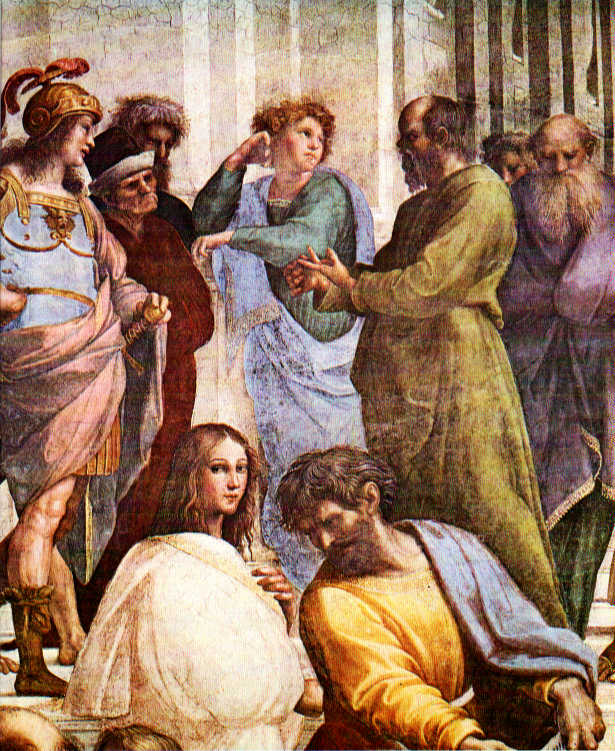
Image credits: Manuscript of Sughrat (Socrates) from a 13th century Seljuk illustrator. Currently kept at Topkapi Palace Library, Istanbul, Turkey; Socrates lecturing, from Raphael's School of Athens, Stanza dei Conservatori, Vatican. Both from Wikimedia Commons.

Thursday, September 25, 2008

Slouching toward Revolution

I’ve probably mentioned environmentalist and educator David Orr in other posts on another blog, but as I was scooting though my bookmarks looking for something else, I happened on an essay he wrote in 1991 for a special issue of In Context, A Quarterly of Humane Sustainable Culture, and reprinted online in 1996. Orr's article called "What is Education For? Six myths about the foundations of modern education and six new principles to replace them," and it appears in the the issue on The Learning Revolution: Education Innovations for Global Citizens. Although I don't agree with every author of every article, the issue provides interesting insights into the educational climate of the emerging global economy at the turn of the twenty-first century.

This is the situation the editors described seventeen years ago:

It takes only a glance at the newsstands to know that education is in deep trouble. In France, 250,000 students recently took to the streets to protest unsafe conditions and reduced education budgets. In the U.S., public schools in some parts of the country are being all but abandoned by those who can afford private alternatives. And around the world, education - preparing the next generation to lead productive and fulfilling lives - too often suffers from being on the short end of a dwindling resource stream.

Sound familiar? The editors then envisioned a revolution in learning that could meet the demands of a changing world; it wouldn't necessarily involve a huge economic investment in technology, but rather "a shift in the way we understand what it means to learn and to teach" and changes in "our ideas about learning."

The hope reflected in these articles, including Orr's, is palpable, and is grounded in a move away from long-held beliefs not only about education, but about economy in general. Education becomes not merely a means to becoming rich and famous, but toward something much more important and (the essays suggest) fulfilling.

But learning for what? We are already far too skilled in exploiting the Earth for human ends, yet we are still terribly ignorant about the real basics of life - how to live sustainably on this planet, and in peace with each other. So whether you consider yourself an educator, a learner, or a concerned citizen, this issue is for you; for if the insights and technologies gathered here were put to the service of healing our societies and the planet's life systems, they would spark a revolution of enormous - and beautiful - proportions. We hope you'll participate in making that vision a reality.

Needless to say, the revolution never seems to have arrived. What Alan AtKisson describes in his introductory essay is still very much the case:

We are in a time when the destructive power of our ignorance is casting cold shadows across our knowledge - and the integrity of many species, cultures, and natural systems is being eclipsed in the process.

David Orr's response (from a commencement address he delivered in 1990) remains current, and his observations could have been taken from this morning's headlines:

The truth is that many things on which your future health and prosperity depend are in dire jeopardy: climate stability, the resilience and productivity of natural systems, the beauty of the natural world, and biological diversity.

Add to this a rapidly failing economy here in the United States (which promises to engulf much of the rest of the world unless it's properly addressed), and then make note, as Orr does, of the fact that these crises were not effected by uneducated people. The environmental and economic "challenges" (to use a word popular in educational circles today) have been wrought by a particular kind of ignorance against which our current forms of education do not insulate us.

People actually seem to be twigging to the idea that book-learning is not in itself the sole source of experience and wisdom. I can't help but blame the popularity of self-proclaimed populists like John McCain and Sarah Palin (and even George Bush) on the perception that those ivory-tower elites have gotten us into this mess (even if they were Conservative elites, they were still from Yale and Harvard). Never mind that we've had eight years of folksy leadership from a guy who was elected in part because he was the kind of fella you'd like to have a beer with, and we're considerably worse off as a result. It's the perception that counts, and it dogs candidates like Harvard-grad Barack Obama, who gets advice from pundits to "dumb it down." (I actually heard a commentator suggest this on Hardball the other night.)

It is rather ironic that some of our problems are actually grounded in knowledge, or at least in our tendency to read philosophy uncritically. Orr points to Francis Bacon, Galileo, and Descartes as sources for our traditional separation of human beings from the natural world--and notes that these are the foundations of modern educational theory, "foundations now enshrined in myths we have come to accept without question." He goes on to discuss six: Ignorance is a solvable problem; with enough knowledge and technology we can manage planet Earth; knowledge is increasing and by implication human goodness; we can adequately restore that which we have dismantled; the purpose of education is that of giving you the means for upward mobility and success; and our culture represents the pinnacle of human achievement. His careful explication of each of these presumptions is worth reading and considering.

Even though the revolution he was advocating in the '90s still hasn't occurred nearly twenty years later doesn't mean that the solutions he poses aren't still possible or necessary. The six principles he considers as solutions include these: All education is environmental education; the goal of education is not mastery of subject matter, but of one's person (from the Greek notion of paideia); knowledge carries with it the responsibility to see that it is well used in the world; we cannot say that we know something until we understand the effects of this knowledge on real people and their communities; "minute particulars" and the power of examples over words are important (my variation on this principle is "you are what you do," and because we are by nature metaphor makers, example carries enormous weight); and the way learning occurs is as important as the content of particular courses.

I'm doing Orr an injustice by simply listing his problems and solutions. But I hope that by doing so, I will pique my readers' interest strongly enough for them to engage in a careful reading of his essay. And then, for homework, go on to read his book The Nature of Design: Ecology, Culture, and Human Intention. It's an education in itself.

Photo credit: The abandoned Granger elementary school in Tucumcari, New Mexico, by Wordbuilder. Wikimedia Commons.