
I’ve probably mentioned environmentalist and educator David Orr in other posts on another blog, but as I was scooting though my bookmarks looking for something else, I happened on an essay he wrote in 1991 for a special issue of
In Context, A Quarterly of Humane Sustainable Culture, and reprinted online in 1996. Orr's article called "
What is Education For? Six myths about the foundations of modern education and six new principles to replace them," and it appears in the the issue on
The Learning Revolution: Education Innovations for Global Citizens. Although I don't agree with every author of every article, the issue provides interesting insights into the educational climate of the emerging global economy at the turn of the twenty-first century.
This is the situation
the editors described seventeen years ago:
It takes only a glance at the newsstands to know that education is in deep trouble. In France, 250,000 students recently took to the streets to protest unsafe conditions and reduced education budgets. In the U.S., public schools in some parts of the country are being all but abandoned by those who can afford private alternatives. And around the world, education - preparing the next generation to lead productive and fulfilling lives - too often suffers from being on the short end of a dwindling resource stream.Sound familiar? The editors then envisioned a revolution in learning that could meet the demands of a changing world; it wouldn't necessarily involve a huge economic investment in technology, but rather "a shift in the way we understand what it means to learn and to teach" and changes in "our ideas about learning."
The hope reflected in these articles, including Orr's, is palpable, and is grounded in a move away from long-held beliefs not only about education, but about economy in general. Education becomes not merely a means to becoming rich and famous, but toward something much more important and (the essays suggest) fulfilling.
But learning for what? We are already far too skilled in exploiting the Earth for human ends, yet we are still terribly ignorant about the real basics of life - how to live sustainably on this planet, and in peace with each other. So whether you consider yourself an educator, a learner, or a concerned citizen, this issue is for you; for if the insights and technologies gathered here were put to the service of healing our societies and the planet's life systems, they would spark a revolution of enormous - and beautiful - proportions. We hope you'll participate in making that vision a reality.Needless to say, the revolution never seems to have arrived. What Alan AtKisson describes in his
introductory essay is still very much the case:
We are in a time when the destructive power of our ignorance is casting cold shadows across our knowledge - and the integrity of many species, cultures, and natural systems is being eclipsed in the process.David Orr's response (from a commencement address he delivered in 1990) remains current, and his observations could have been taken from this morning's headlines:
The truth is that many things on which your future health and prosperity depend are in dire jeopardy: climate stability, the resilience and productivity of natural systems, the beauty of the natural world, and biological diversity.Add to this a rapidly failing economy here in the United States (which promises to engulf much of the rest of the world unless it's properly addressed), and then make note, as Orr does, of the fact that these crises were not effected by uneducated people. The environmental and economic "challenges" (to use a word popular in educational circles today) have been wrought by a particular kind of ignorance against which our current forms of education do not insulate us.
People actually seem to be twigging to the idea that book-learning is not in itself the sole source of experience and wisdom. I can't help but blame the popularity of self-proclaimed populists like John McCain and Sarah Palin (and even George Bush) on the perception that those ivory-tower elites have gotten us into this mess (even if they were Conservative elites, they were still from Yale and Harvard). Never mind that we've had eight years of folksy leadership from a guy who was elected in part because he was the kind of fella you'd like to have a beer with, and we're considerably worse off as a result. It's the perception that counts, and it dogs candidates like Harvard-grad Barack Obama, who gets advice from pundits to "dumb it down." (I actually heard a commentator suggest this on
Hardball the other night.)
It
is rather ironic that some of our problems are actually
grounded in knowledge, or at least in our tendency to read philosophy uncritically. Orr points to Francis Bacon, Galileo, and Descartes as sources for our traditional separation of human beings from the natural world--and notes that these are the foundations of modern educational theory, "foundations now enshrined in myths we have come to accept without question." He goes on to discuss six:
Ignorance is a solvable problem;
with enough knowledge and technology we can manage planet Earth;
knowledge is increasing and by implication human goodness;
we can adequately restore that which we have dismantled;
the purpose of education is that of giving you the means for upward mobility and success; and
our culture represents the pinnacle of human achievement. His careful explication of each of these presumptions is worth reading and considering.
Even though the revolution he was advocating in the '90s still hasn't occurred nearly twenty years later doesn't mean that the solutions he poses aren't still possible or necessary. The six principles he considers as solutions include these:
All education is environmental education;
the goal of education is not mastery of subject matter, but of one's person (from the Greek notion of
paideia);
knowledge carries with it the responsibility to see that it is well used in the world;
we cannot say that we know something until we understand the effects of this knowledge on real people and their communities;
"minute particulars" and the power of examples over words are important (my variation on this principle is "you are what you do," and because we are by nature metaphor makers, example carries enormous weight); and
the way learning occurs is as important as the content of particular courses.
I'm doing Orr an injustice by simply listing his problems and solutions. But I hope that by doing so, I will pique my readers' interest strongly enough for them to engage in a careful reading of his essay. And then, for homework, go on to read his book
The Nature of Design: Ecology, Culture, and Human Intention. It's an education in itself.
Photo credit: The abandoned Granger elementary school in Tucumcari, New Mexico, by Wordbuilder. Wikimedia Commons.

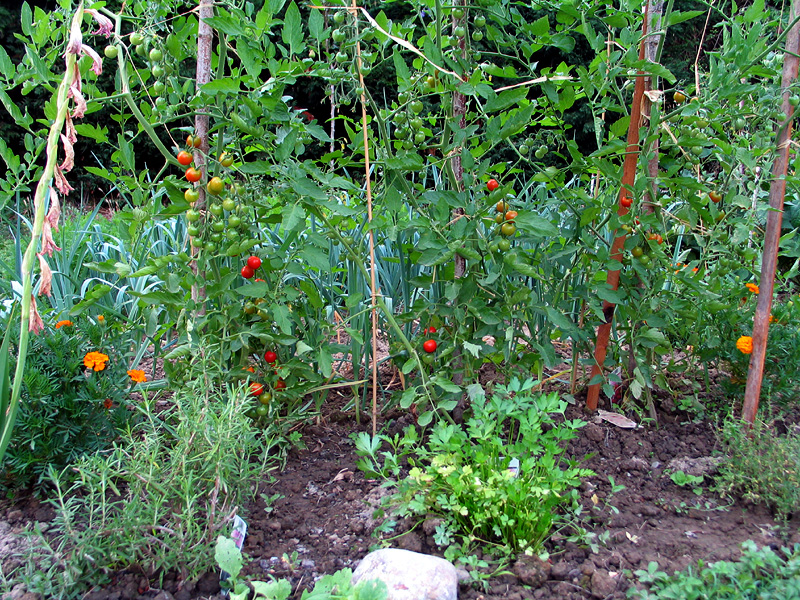 Back when I used to live in East Dallas, I'd often drive by Stonewall Jackson Elementary school on Mockingbird Lane. It's a fairly nondescript little school, but it sports a terrific garden that's visible from the street. I'd often see folks from the community, as well as the children, puttering around, and I was always amazed at how lovely, inviting, and verdant it looked.


